Sunday, September 26, 2010
I have a new blog!
It's integrated into my website—check it out! My whole Blogger archive is available over there as well. Huge thanks to David Galli, who did (and is doing) an awesome job designing it. Isn't this exciting?


Sunday, September 19, 2010
Adventures in Peru: the Amazon, part 1
 A colorful crush of traffic on the way into Iquitos.
I enjoyed every minute we spent in Peru, but our time in the Amazon was particularly special. Kate, Jill and I took the overnight bus from Trujillo back to Lima, then flew to Iquitos, which is where you take the boat into the jungle. (You pass through a market on your way to the dock, and our guide pointed out a stall selling weevil shishkebabs. Needless to say, I had no wish to linger.)
We were trying to decide between two tour operators the night before we left, one kinda slick and touristy but with whom we knew more what to expect, and in the end we went (and were really happy) with the alternative, Otorongo Expeditions. The jungle lodge is really quaint and peaceful and comfortable, the owners and staff are fantastic (especially Oscar, our guide), every meal was vegetarian-friendly and thoroughly delicious, and we saw amazing wildlife on every excursion. We can't recommend Otorongo highly enough.
 Taking the (usually horse-powered) sugar cane press for a spin at the rum factory on our way to the lodge. Afterwards we got a taste test, and as you can see Kate didn't like it as much as I did:
 Below: the walkway between the dining and guest rooms at the lodge; the resident macaws; dragon's blood, good for all sorts of skin ailments; breadfruit.


 Swaying in the hammock room at the lodge listening to all those layers of sound coming from the forest around us—the calls of birds, insects, frogs, and monkeys—oh, it was one of the most tranquil experiences of my life!
 Reading The Time Machine in my favorite place.
Next post: wildlife photos!
Monday, September 13, 2010
Adventures in Peru: North of Lima, part 2
(North of Lima, part 1.)
We based ourselves in Trujillo for Chan Chan, Huaca de la Luna, and el Brujo; the first two sites are a short collectivo ride (i.e., local minibus service) outside the city, and el Brujo is about an hour distant. There isn't a heck of a lot going on in Trujillo itself, although there was quite a bit of interesting colonial architecture.
 One of many ornate screened balconies where a lady might look out on the street without being seen from below.
 One evening we wandered into the courtyard of a private club.
Most memorable, however, is the sketchy guesthouse in which we caught one of the desk clerks in our bathroom, claiming to be cleaning it at six o'clock in the evening (naturally, with no cleaning products to hand). Nothing was missing from the room, but I was still suspicious. 'He was sticking his nose in our underwear,' I said. 'It's the only logical explanation.'
 Chan Chan, built by the Chimú in the ninth century, was a vast city constructed entirely of adobe. Plentiful pelican, fish, and otter motifs, and the diamond-shaped walls (fishing nets!), show how the Chimú appreciated what the sea provided.
 (See the otters on the walls?)
The next day we did Huaca de la Luna (Moon Handbooks link here), the 'Temple of the Moon.' I think this was our favorite archaeological site (it was definitely mine)—fascinating polychrome wall reliefs (giant spiders, vanquished warriors in neck chains being led to sacrifice), excellent guide, totally adorable Peruvian schoolgirls. There are two huge adobe structures here, both constructed by the Moche people layer upon layer over successive generations during the first millennium A.D.—the Temple of the Moon was used for religious and ceremonial purposes, the nearby Temple of the Sun for the military and administrative stuff. The Temple of the Sun, looted by the conquistadores, is still undergoing excavation work and isn't yet open to the public. Children used to play soccer on the sand before these ruins were discovered underneath.
 I know this shot must look kind of posed and phony, but honestly it isn't—our guide was about to snap a photo of the three of us, and these adorable little girls were shyly watching on, and we invited them to come over.
I also took a panorama at Huaca de la Luna—I don't know why it's playing so jerkily, but you get the idea:
By our last day in Trujillo we were a little bit ruined out, but el Brujo (another city constructed by the Moche between 1400 and 2000 years ago) was still very much worth the visit, particularly for the Señora de Cao, a young woman who was evidently a very powerful political leader. Her mummy was discovered in 2006 along with a fifteen-year-old handmaiden sacrificed presumably to tend to her needs in the afterlife; experts concluded the Señora had died in childbirth around the age of twenty.
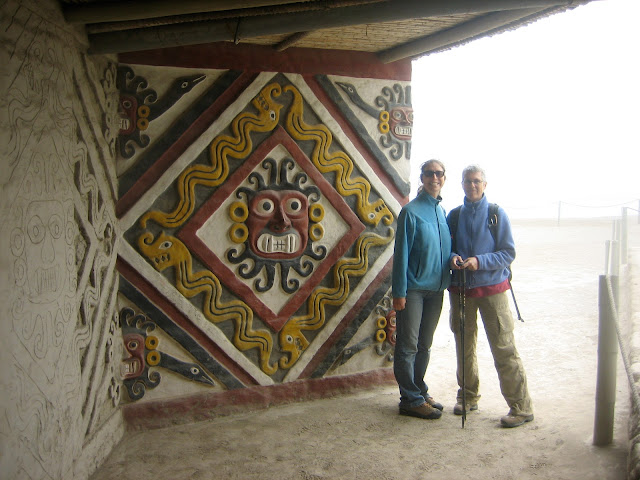 What the walls probably would have looked like a millennium and a half ago. If I remember correctly, this is Ayapec, 'the great decapitator.' Eep!
The brand-new museum at el Brujo houses the mummy of the Señora de Cao, and you can still see the undulating tattoos on her arms. I was really fascinated to discover that when you look into the glass case you aren't actually looking at the Señora, but at a mirror image; the mummy is lying safely out of sight. I was trying to figure out why the sight of the mummy at Sechin bothered me so much when I was only in awe of the Señora—it must be because of who they were in life. The Señora was entombed in layers of precious cloth and gold baubles, while it seems cruel to display the body of the sacrificed girl when she'd already had to suffer that supreme indignity. Anywho.
Next post: THE JUNGLE!
We based ourselves in Trujillo for Chan Chan, Huaca de la Luna, and el Brujo; the first two sites are a short collectivo ride (i.e., local minibus service) outside the city, and el Brujo is about an hour distant. There isn't a heck of a lot going on in Trujillo itself, although there was quite a bit of interesting colonial architecture.
One of many ornate screened balconies where a lady might look out on the street without being seen from below.One evening we wandered into the courtyard of a private club.Most memorable, however, is the sketchy guesthouse in which we caught one of the desk clerks in our bathroom, claiming to be cleaning it at six o'clock in the evening (naturally, with no cleaning products to hand). Nothing was missing from the room, but I was still suspicious. 'He was sticking his nose in our underwear,' I said. 'It's the only logical explanation.'
Chan Chan, built by the Chimú in the ninth century, was a vast city constructed entirely of adobe. Plentiful pelican, fish, and otter motifs, and the diamond-shaped walls (fishing nets!), show how the Chimú appreciated what the sea provided.(See the otters on the walls?)The next day we did Huaca de la Luna (Moon Handbooks link here), the 'Temple of the Moon.' I think this was our favorite archaeological site (it was definitely mine)—fascinating polychrome wall reliefs (giant spiders, vanquished warriors in neck chains being led to sacrifice), excellent guide, totally adorable Peruvian schoolgirls. There are two huge adobe structures here, both constructed by the Moche people layer upon layer over successive generations during the first millennium A.D.—the Temple of the Moon was used for religious and ceremonial purposes, the nearby Temple of the Sun for the military and administrative stuff. The Temple of the Sun, looted by the conquistadores, is still undergoing excavation work and isn't yet open to the public. Children used to play soccer on the sand before these ruins were discovered underneath.
I know this shot must look kind of posed and phony, but honestly it isn't—our guide was about to snap a photo of the three of us, and these adorable little girls were shyly watching on, and we invited them to come over.I also took a panorama at Huaca de la Luna—I don't know why it's playing so jerkily, but you get the idea:
By our last day in Trujillo we were a little bit ruined out, but el Brujo (another city constructed by the Moche between 1400 and 2000 years ago) was still very much worth the visit, particularly for the Señora de Cao, a young woman who was evidently a very powerful political leader. Her mummy was discovered in 2006 along with a fifteen-year-old handmaiden sacrificed presumably to tend to her needs in the afterlife; experts concluded the Señora had died in childbirth around the age of twenty.
What the walls probably would have looked like a millennium and a half ago. If I remember correctly, this is Ayapec, 'the great decapitator.' Eep!The brand-new museum at el Brujo houses the mummy of the Señora de Cao, and you can still see the undulating tattoos on her arms. I was really fascinated to discover that when you look into the glass case you aren't actually looking at the Señora, but at a mirror image; the mummy is lying safely out of sight. I was trying to figure out why the sight of the mummy at Sechin bothered me so much when I was only in awe of the Señora—it must be because of who they were in life. The Señora was entombed in layers of precious cloth and gold baubles, while it seems cruel to display the body of the sacrificed girl when she'd already had to suffer that supreme indignity. Anywho.
Next post: THE JUNGLE!
Thursday, September 9, 2010
Adventures in Peru: North of Lima, part 1
 One of the ruins at Caral, a city over four thousand years old.
There were three phases to our adventure in Peru: first Kate and Jill and I spent four or so days doing the archaeological sites along the coast north of Lima; then the three of us took an overnight bus back to Lima followed by a flight to Iquitos, where we made arrangements for a stay at a lodge on the Amazon. There were four marvelous days in the jungle. Then we flew back to Lima to meet up with Elliot and Spencer, and we did the more touristy parts—Machu Picchu, Lake Titicaca, the Sacred Valley, etc.
Anyway, we visited five pre-Incan archaeological sites on the first part of the trip: Caral, the oldest city in the Americas; Sechin, the home of a warlike culture dating between 1800 and 900BC; Chan Chan, the largest adobe city ever built; Huaca de la Luna, built by the Moche, who flourished during the first millennium A.D.; and el Brujo (also Moche), home of the tomb and mummy of the Señora de Cao—a powerful female ruler whose arm tattoos are still clearly visible. (More on her next time.)
 At Caral we met Nathalie, a lovely Frenchwoman who lived in Spain for many years and was traveling on her own for a few weeks before meeting up with her boyfriend. We took a taxi back into town together and had dinner at a little restaurant by the sea (which was a lot less picturesque than it sounds, but it was still a nice time).
 Charming.
 A view over the ruins at Sechin from the walkway that goes up the hill behind it and around the site.
Sechin was a much smaller site, and we were able to walk around without a guide. There's a small museum, and in the basement we were appalled to find the preserved body of a teenaged sacrificial victim stuffed on the bottom shelf of a rickety glass case. Jill was saying something about mummies actually being comforting to her somehow, not creepy, but then she amended her statement: 'Well, I didn't find her comforting because she was buried alive...' Her mouth was wide open. Taken with the bloodthirsty nature of the stone carvings that Sechin is known for, this one was certainly the most disturbing of our archaeological visits.
 If you'd been unlucky enough to be born here three thousand years ago, this is the guy who would have chopped off your head to feed the sun god. Or maybe just for kicks.
 And now for something completely different. We saw these signs on every bus:
 ("Only for number one.")
I must say this perplexed me greatly. Like, what if I can't help it?
 This was one of those situations where the sights blow you away but the towns you've got to sleep in aren't quite so amazing—although we did manage to find a friendly little spot in Barranca (our base for Caral) for jugo de piña and some breakfast cake.
Next post: Chan Chan, Huaca de la Luna, and el Brujo.
Saturday, September 4, 2010
Harmony Homestead Dispatch #9
On my last day in Vermont, Paul and Niki and I met Michael (otherwise known as 'the boy with the long red hair') at his shop for lunch. He restores pianos in this spooky factory space built in 1904:

 I found cool stuff inside besides the instruments.
 Niki played this gorgeous piano dating from 1890, and nearly had a heart attack when I told her later that it costs $36,000!
 This one's a pump organ, if I'm not mistaken.
 After lunch at Wicksticker's (where, like I said, we had beer and peppermint schnapps on the house), Michael took me back to the shop for a little while, but it was too nice an afternoon to work. So we went for a swim.
 Our favorite swimming spot on the Poultney River.

 It was a perfect last day—at the end of it Gail made her sublimely delicious enchiladas, and we had this for dessert:
 (This holy mother of all fruit tarts is from a bakery in Middlebury, but she makes amazing desserts too. Gail is one of those enviable people who can, seemingly without effort, turn a random pile of raw ingredients into edible gold.)
I'm going back to Vermont in a week or so, so I'll have more photos to post then!
I found cool stuff inside besides the instruments.Niki played this gorgeous piano dating from 1890, and nearly had a heart attack when I told her later that it costs $36,000!This one's a pump organ, if I'm not mistaken.After lunch at Wicksticker's (where, like I said, we had beer and peppermint schnapps on the house), Michael took me back to the shop for a little while, but it was too nice an afternoon to work. So we went for a swim.Our favorite swimming spot on the Poultney River.It was a perfect last day—at the end of it Gail made her sublimely delicious enchiladas, and we had this for dessert:(This holy mother of all fruit tarts is from a bakery in Middlebury, but she makes amazing desserts too. Gail is one of those enviable people who can, seemingly without effort, turn a random pile of raw ingredients into edible gold.)I'm going back to Vermont in a week or so, so I'll have more photos to post then!
Wednesday, September 1, 2010
Said and Unsaid
I was thinking about dialogue on the Greyhound bus ride home the other day. I have borrowed many a good line from strangers on public transport—the gem of that trip was 'Have you been to the bathroom in Baltimore? I felt safer in prison'—and sometimes these lines are so good they sound like they HAVE to have been made up.
Here's an example. I wrote the following, and my editor asked me to change it because she couldn't imagine anyone actually speaking this way:
What can really make good dialogue, though, is all the things that go unsaid. Here's another exchange I scribbled down on Monday afternoon:
Here's an example. I wrote the following, and my editor asked me to change it because she couldn't imagine anyone actually speaking this way:
Every so often I get a craving for the kind I can’t find at night. You know the sort of man I mean: a vegetarian Buddhist in thrift-store corduroys, doesn’t drink, rarely pays a visit to the barber. Last time I found one I was coming home on the PATH train at half past six on a Sunday morning; he boarded with a friend, both with twelve-speed bicycles in tow. I knew I had to have him when I heard him say, “You know when you’re riding down a country road and come upon the skeleton of a barn? I love that.” He didn’t notice me then, but I made sure he left his pocket journal on the train...Yes, I heard a guy say that, word for word. I loved how much that offhand remark told me about his personality, and the well cared for bicycle at his side reinforced my impression. I didn't go home with that boy, but Eve sure did.
What can really make good dialogue, though, is all the things that go unsaid. Here's another exchange I scribbled down on Monday afternoon:
HE: So...are you going to be around long enough for us to go out?This reminds me of nights in the study room back in grad school, when Seanan would write two lines for every one line of dialogue he composed: one for what was coming out of the character's mouth, and the second for what he was actually saying. Dialogue—reading it, writing it, overhearing and 'appropriating' it—is one of the most delightful aspects of being a storyteller, and doing it well makes it just as satisfying for the reader.
Something about being on a Greyhound bus gets me really horny. You'll do.
SHE: I don't think so. I'm too old for that shit.
I'll talk to you across the aisle, but there's no way in hell I'm going back behind the dumpster with you at the next pit stop.
HE: Yeah, I don't do the bus thing either.
[a moment later] But I can cook up seafood better than you can buy it at the harbor.
I'm gonna pretend like you didn't just shut me down. In fact, I'm gonna give you one more chance, because I haven't met a woman yet who could resist my crabcakes...
Monday, August 30, 2010
Home from Peru!
Welp, I'm back. It was such a fantastic trip that I felt none of the usual 'I've been gone long enough, I'll be glad to get home again.' I just feel melancholy.
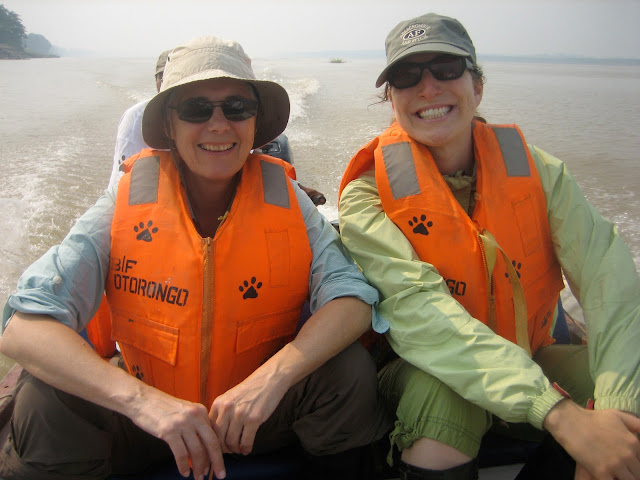 Jill and Kate on the Amazon.
We saw and heard marvelous creatures in the jungle, oohed and ahhed at pink river dolphins making brief appearances above the surface of the Amazon, walked up and down temples where young girls were sacrificed to old gods, got all our bones jangled in tiny moto-taxis (I called them putt-putts), watched condors wheeling over Colca Canyon and climbed up Machu Picchu (the mountain the city is named after, that is). The food was far better than we were expecting (surprisingly veggie-friendly), and I've never laughed so hard in my life.
So here are some random highlights—I won't start blogging in earnest until next weekend, when I get to download Kate's pictures.
 It vants to suck your blood.
 Rum is YUM.
[Oh, and for the benefit of those few readers—if any, bwahahaha —who are not related to me, I should clarify that Kate and I went with Kate's boyfriend Elliot, his mother Jill, and his brother Spencer. It was Jill and Kate and I for the first half—when we did a bunch of pre-Incan archaeological sites like Chan Chan and Huaca de la Luna, then spent four days at a jungle lodge on the Amazon—and then we went back to Lima to meet up with Elliot and Spencer, and that's when we did Machu Picchu and all that.]
 This is what happens when you fall asleep in the taxi.
 At Machu Picchu. I don't know what is going on here.
 Spencer, Jill, and Elliot, waiting for our flight to Cuzco. Elliot finished Petty Magic on the trip. I get four and a half stars.
 Cool doorknocker in Trujillo, our base for exploring Huaca de la Luna and other archaeological sites. We disapprove of the Spaniards for all the disease and violence they wrought upon the natives, but must admit the colonial architecture is splendid.
Jill and Kate on the Amazon.We saw and heard marvelous creatures in the jungle, oohed and ahhed at pink river dolphins making brief appearances above the surface of the Amazon, walked up and down temples where young girls were sacrificed to old gods, got all our bones jangled in tiny moto-taxis (I called them putt-putts), watched condors wheeling over Colca Canyon and climbed up Machu Picchu (the mountain the city is named after, that is). The food was far better than we were expecting (surprisingly veggie-friendly), and I've never laughed so hard in my life.
So here are some random highlights—I won't start blogging in earnest until next weekend, when I get to download Kate's pictures.
It vants to suck your blood.Rum is YUM.[Oh, and for the benefit of those few readers—if any, bwahahaha —who are not related to me, I should clarify that Kate and I went with Kate's boyfriend Elliot, his mother Jill, and his brother Spencer. It was Jill and Kate and I for the first half—when we did a bunch of pre-Incan archaeological sites like Chan Chan and Huaca de la Luna, then spent four days at a jungle lodge on the Amazon—and then we went back to Lima to meet up with Elliot and Spencer, and that's when we did Machu Picchu and all that.]
This is what happens when you fall asleep in the taxi.At Machu Picchu. I don't know what is going on here.Spencer, Jill, and Elliot, waiting for our flight to Cuzco. Elliot finished Petty Magic on the trip. I get four and a half stars.Cool doorknocker in Trujillo, our base for exploring Huaca de la Luna and other archaeological sites. We disapprove of the Spaniards for all the disease and violence they wrought upon the natives, but must admit the colonial architecture is splendid.I love this doorknocker in particular because of the ring. I wore my grandmother's ring on my finger for most of the trip because Lonely Planet says it's not a bad idea to invent a boyfriend or husband.
Kate: How's your marriage going?More soon.
Me: Great! We never fight!
Subscribe to:
Posts (Atom)
