Showing posts with label books. Show all posts

Saturday, July 24, 2010

Blurbs and other fun stuff

Fun book stuff is starting to happen! Petty Magic recently got a couple of lovely blurbs from two of my favorite authors:
A charming curiosity shop of a novel, packed to bursting with secret histories and glittering marvels. With Petty Magic, Camille DeAngelis has given us a glimpse into a strange and enchanting world. It's dangerous good fun, and well worth getting lost in.
Jedediah Berry, author of The Manual of Detection

Love, magic, history, witches: it's all here, between the covers of this lovely book. Updike might have written it, if he'd had a better sense of humor.
Daniel Wallace, author of Big Fish and Mr. Sebastian and the Negro Magician
(Also, in case you missed it, you might want to read my post about how Daniel has inspired me.)

The other exciting thing is this profile published Thursday in my local newspaper, the Burlington County Times!

I'm also working with the designer of these two fabulous websites to come up with a brand-new blog; more about that later.

Thursday, July 22, 2010

Operation Mincemeat

World War II offers us far more interesting, amusing and subtle examples of intelligence work than any writer of spy stories can devise.
—Admiral John Godfrey

In Petty Magic, I refer to a couple of the most spectacular World War II hoaxes, both of which were part of a larger deception plan, Operation Barclay—constructing sham army camps to fool Nazi reconnaissance, and planting phony intelligence documents on a corpse in uniform. It took several incredibly imaginative, 'corkscrew-minded' intelligence officers to hatch each of these plots, and in my novel I give all the credit to my magician-spy, Neverino. These hoaxes were first devised not by a magician, but a novelist!

The hoax involving a corpse in uniform was codenamed Operation Mincemeat (Churchill had forbidden the use of obvious or jokesy code names, but apparently no one listened to him), and it's the subject of a riveting new book by British journalist Ben Macintyre.

To begin regaining control of Europe in the summer of 1943, the Allies first needed to take back Sicily—and the Germans were just as aware of its strategic importance. Taking advantage of Hitler's 'Balkan fixation' (because the Third Reich got most of its raw materials from Romania, Bulgaria, and Yugoslavia), the Allies would convince him that they were planning to invade Sardinia and Greece instead, and that Sicily was the phony target.

Human agents or double agents can be tortured or turned, forced to reveal the falsity of the information they carried. A dead body would never talk.

So here's the gist: the corpse-with-phony-identification idea originated in Basil Thomson's novel, The Milliner's Hat Mystery, published in 1937. Ian Fleming, the naval intelligence officer who would later pen the James Bond novels, was a fan of Thomson's, and he included it in the "Trout Memo," a list of possible hoaxes that was distributed among the intelligence chiefs at the very beginning of the war. Two other officers in MI5—the eccentric, unassuming Charles Cholmondeley ("Chumly") and the supremely confident lawyer Ewen Montagu—developed the idea and saw it to fruition.

Once the higher-ups at MI5 consented to the ruse, these two officers embarked on an elaborate planning process. St. Pancras coroner Bentley Purchase informed them that the body of a homeless Welshman, Glyndwr Michael, had just been brought in, and Cholmondeley and Montagu spent the next couple of months (with Michael in deep refrigeration) inventing his alter-ego, Major William Martin, complete with love letters and photographs, hotel bills, and snippy missives from his father and bank manager. Cholmondeley and Montagu spent so much time inventing him that they began to feel as if Martin had actually been a friend of theirs.

Cholmondeley, Montagu, and the other planners knew how the Nazis thought—their two biggest flaws (with regard to military intelligence and espionage, anyway) being 'wishfulness and yesmanship'—and if they could allow those phony documents to fall into the right hands, thousands of lives would be saved on both sides.

The operation got off as planned, and by the time 'Major Martin' arrived in Huelva, Spain, he stunk so bad the local forensic pathologist dismissed the inevitable anomalies (the corpse's face and the face on his ID card didn't quite match up; the body was too decomposed to have been in the water only a few days, as his documents attested) in favor of getting the heck out of the room. The body was laid to rest in a Catholic cemetery, and the suitcase and its contents got lost in a maze of Spanish bureaucracy and intrigue before the Nazis finally got their hands on it. The rumor of a Greek invasion spread, and thus began to substantiate itself; Hitler was convinced, and the ruse was complete.

The material is fascinating regardless, but Macintyre does a great job of bringing to life each character involved in the plot of Operation Mincemeat—from the aforementioned jolly coroner of St. Pancras ('He loved Gilbert and Sullivan operas, toy trains, boiled eggs, and his model piggery in Ipswich. He never wore a hat and laughed loudly and often') to the brave submarine commander assigned to the dispatch of 'Major William Martin', Bill Jewell, who only begins to fear for his life after falling in love with a Wren in Algiers. We get a keen sense of each player's desires and ambitions, their private histories and their miserable working conditions.

So why are so many details of the planning of Operation Mincemeat only now coming to light? After the war was over, there was still the possibility of a political backlash were the full story of the hoax to come out. British diplomats had conspired to deceive Spanish officials, so the revelation would have no doubt damaged Anglo-Spanish relations; furthermore, back at home, those who had orchestrated Operation Mincemeat had obtained the corpse by not-strictly-legal means, and exposure would have caused quite a bit of trouble for the coroner and other government offices involved in that particular aspect of the deception.

So, in The Man Who Never Was and on the international lecture circuit, Ewen Montagu spent forty years telling a story that was hopelessly incomplete—for the above reasons, and because Cholmondeley and several others abided by their MI5 oaths of secrecy for the rest of their lives. Macintyre had access to Montagu's personal archives, and along with information that has become available only in the last twenty years or so, he was able to write the most complete account of Operation Mincemeat we'll probably ever have. Its unputdownability is a testament to Macintyre's prowess as a storyteller. Highly, highly recommended.

[Edit: Since I wrote this I found there's another book on the subject that's also come out this year called Deathly Deception: The Real Story of Operation Mincemeat by Denis Smyth. It'd be interesting to compare them.]

Monday, June 14, 2010

I ♥ Angela Carter, part 2

(I ♥ Angela Carter, part 1.)

At midnight, especially on Walpurgisnacht, the Devil holds picnics in the graveyards and invites the witches; then they dig up fresh corpses, and eat them. Anyone will tell you that.

(from 'The Werewolf')


This is the most beautiful book I own.

It's the first U.S. edition of The Bloody Chamber (published in 1977), a collection of deliciously creepy retellings of classic fairy tales and legends like Bluebeard's Chamber, the Erlking, and Beauty and the Beast. The heroines of these stories are brave and sensuous and morbid; the collection's usually pegged as 'feminist fairy tales' but they're so much more fun than that label lets on.

One of my favorite stories is 'The Lady of the House of Love'; as you read it you can totally imagine yourself as the 'beautiful queen of the vampires', alone in the gloom of her ruined chateau:
Closely barred shutters and heavy velvet curtains keep out every leak of natural light. There is a round table on a single leg covered with a red plush cloth on which she lays out her inevitable tarot; this room is never more than faintly illuminated by a heavily shaded lamp on the mantelpiece and the dark-red figured wallpaper is obscurely, distressingly patterned by the rain that drives in through the neglected roof and leaves behind it random areas of staining, ominous marks like those left on the sheets by dead lovers. Depredations of rot and fungus everywhere. The unlit chandelier is so heavy with dust the individual prisms no longer show any shapes; industrious spiders have woven canopies in the corners of this ornate and rotting place, have trapped the porcelain vases on the mantelpiece in soft gray nets. But the mistress of all this disintegration notices nothing...
The prose throughout is beautiful and evocative and pleasantly disturbing. There's an awful lot of romanticization of death in popular culture these days—(enough already with all these cheesy vampire sagas!)—and while the stories in The Bloody Chamber are often preoccupied with sex, death, and decay, this is not at all the indulgence of some teenybopper goth fantasy. Her beauty is a symptom of her disorder, of her soullessness.

Like I said, I am rationing the oeuvre of Angela Carter, although I suspect I have already read her best novel—Wise Children, her last, published in 1991. If you've never read her, The Bloody Chamber might be a good place to start.

Friday, May 28, 2010

What's a beldame?

Waterhouse's painting after Keats' poem, "La Belle Dame Sans Merci."

When people ask me about Petty Magic, I usually use the word 'witch' even though my narrator hates that word with a red-hot fiery passion—just because 'witch' is quicker to understand. (There's an old-school witch on the cover, too, spiriting a little girl away on her broomstick—but this is ironically appropriate.)

Think of us as sibyls or seraphs—fearsome, oh yes, but more or less benevolent.

Eve and the other beldames in Petty Magic live at least twice as long as ordinary women but age half as quickly. They can turn themselves into animals, travel thousands of miles in a twinkling, or render themselves invisible, but they get worn out and need to sleep and recharge just like anybody else. They can be sweet and solicitous like fairy godmothers, or...not. And they tell lies, so they say, only to keep the men in black from locking them up.

Because Eve is more superwoman or benign enchantress than vindictive old hag, I wanted a different word for her. In Coraline, Neil Gaiman refers to the 'other mother' as a beldam, as in 'crone' or 'witch' (the word comes from Middle English—bel, grand, and dam, mother, grandmother being the original meaning). In the dictionary 'beldame' is only listed as an alternate spelling, but in "La Belle Dame Sans Merci" (written in 1819, revised in 1820) Keats's beldame is from the French, a 'beautiful lady'—that is to say, a sorceress.
She took me to her elfin grot,
And there she gaz'd and sighed deep,
And there I shut her wild sad eyes--
So kiss'd to sleep.

And there we slumber'd on the moss,
And there I dream'd, ah woe betide,
The latest dream I ever dream'd
On the cold hill side.

I saw pale kings, and princes too,
Pale warriors, death-pale were they all;
Who cry'd—"La belle Dame sans merci
Hath thee in thrall!"
The belle dame is a dangerous woman—a fairy, or a sort of banshee—who, in medieval legend, would lure men into an enchanted forest and make them lose all desire for anything else, even to go on living. The poem harks back to the chivalric tradition, in which 'women were to be loved from afar and to be considered unattainable.'

Another version of "La Belle Dame Sans Merci" by Frank Dicksee.

Archetypes aren't terribly interesting unless you can somehow subvert them (or better yet, subvert and reinforce). Can a 'dangerous woman' have (mostly) good intentions? Maybe not Keats' beldame...but definitely mine.

Thursday, May 13, 2010

The Wind in the Willows, part 2

Especially for you, Pare:

And a better view of the stairs:

Can't even see the house from the street, but I want to live here so bad.

Saturday, May 8, 2010

Witchcraft, Magic & Alchemy

It's high time we had some more witchy stuff on here!

Witchcraft, Magic, and Alchemy by Grillot de Givry has got to be the weirdest book I have ever cracked. The publisher's product description is somewhat misleading:

From raising the dead to foretelling the future, this historical tour of the occult offers a captivating exploration of sorcery and ceremonial magic. Prepared by a noted French historian, it ventures into virtually all of the classical arts, with 375 rare black-and-white illustrations derived from paintings, illuminated manuscripts, sculpture, and architecture.

The author doesn't actually approach the material with the objective eye of a historian; he writes about necromancy and love philters and suchlike as if he actually believes in all this stuff. I can't decide if he's brilliant or cuckoo.
It is also very easy, according to several Black-books, to become invisible by carrying the heart of a bat, a black hen, or a frog under the right arm. A more elegant method is to wear the Ring of Gyges on your finger; you can then become visible or invisible at will simply by turning the stone inward or outward. This ring must be made of fixed mercury; it must be set with a little stone to be found in a lapwing’s nest, and round the stone must be engraved the words, “Jésus passant ✠ par le milieu d’eux ✠ s’en allait.” You must put the ring on your finger, and if you look at yourself in a mirror and cannot see the ring it is a sure sign that it has been successfully manufactured.
How nutty is that? There's plenty more where this came from, but I left the book at Seanan's when I was moving out of Galway and forgot about it while I was in Tipperary, so further excerpts will have to wait.

Thursday, May 6, 2010

Great Book #46: The Wind in the Willows

'It's my world, and I don't want any other. What it hasn't got is not worth having, and what it doesn't know is not worth knowing.'

The Wind in the Willows is one of those classics I really don’t know why I never read. Now I wish I’d read it as a child, because as I was listening to the Librivox recording (with a variety of readers, most of them excellent) I kept thinking too much like an adult:

A toad riding a horse! Rats and moles eating bacon and lobster! Field mice singing Christmas carols! How silly!

I also wish I didn’t know anything about Kenneth Grahame, thanks to “The Tragedy of Mr. Toad.” [Recently it has been pointed out to me what a rubbishy newspaper the Daily Mail is, so I apologize if 'Femail,' etc. offends anybody.] As I was listening, I did often think about how this book was the most substantial thing the love-hungry Alastair ever got from his father…at least according to the article.

But setting all that aside—this really is a lovely book, full of beautiful descriptions of nature and the changing of the days and seasons.
As he sat on the grass and looked across the river, a dark hole in the bank opposite, just above the water's edge, caught his eye, and dreamily he fell to considering what a nice snug dwelling-place it would make for an animal with few wants and fond of a bijou riverside residence, above flood level and remote from noise and dust. As he gazed, something bright and small seemed to twinkle down in the heart of it, vanished, then twinkled once more like a tiny star. But it could hardly be a star in such an unlikely situation; and it was too glittering and small for a glow-worm. Then, as he looked, it winked at him, and so declared itself to be an eye; and a small face began gradually to grow up round it, like a frame round a picture.
Most of the episodes in The Wind in the Willows emphasize that true friendship occasionally entails a bit of personal sacrifice, and that loving your friends for who they are doesn’t mean letting them go off and make outrageous fools (or menaces) of themselves. This is all communicated quite nicely without bonking children over the head with ‘the moral of the story.’ That said, I bet everybody looks forward to those chapters following the exploits of the incorrigibly conceited Toad, because the other animals are too sensible to be anywhere near as interesting.
'Glorious, stirring sight!' murmured Toad, never offering to move. 'The poetry of motion! The REAL way to travel! The ONLY way to travel! Here to-day--in next week to-morrow! Villages skipped, towns and cities jumped--always somebody else's horizon! O bliss! O poop-poop! O my! O my!'

'O STOP being an ass, Toad!' cried the Mole despairingly.
Toad’s gleefully insane obsession with motor-cars, his imprisonment for auto theft and his flamboyant escape and subsequent adventures while impersonating a washerwoman—these passages are even more enjoyable than all the poignant bits about Rat and Mole’s particular friendship, though I feel a bit guilty saying so.

Toad in drag, fleeing the authorities.

[picture the following shrieked by a huuuge British guy with painted-on warts]:
I'm being attacked by a cushion! AHH! I'm being attacked by a shoe! AHH! I'm being attacked by my foot! AHH!
—Toad in the Masterpiece Theatre version of "The Wind in the Willows"

Wednesday, May 5, 2010

I ♥ Shaye

Something really crappy happened in the publishing world last week.

Let me back up. From the day I got my Mary Modern book deal (14 March 2006—can't ever forget a date that important), I felt really happy to be a part of Shaye Areheart Books. Shaye and Sally (my editor on Mary Modern) always made me feel not only that they loved my book, but that they cared about me personally. I got the impression that it wouldn't make one bit of difference to Shaye if I never made a bestseller list, so long as I kept telling good stories.

Now, this sort of thing happens quite a bit—CEOs and other folks in lofty positions occasionally get ousted in publishing just like any other business—and I don't want this to turn into an anti-corporate rant or anything. (Well, all right: I composed the rant, and have just hit 'delete'.) I just wanted to ask that when you pick up a hardcover copy of Petty Magic this fall, stop and look at the colophon on the spine. It ought to have been a steaming coffee cup, with SHAYE AREHEART BOOKS written underneath.

Thursday, April 15, 2010

84 Charing Cross Road

I never knew a book could be such a joy to the touch.

While we were in London Deirdre was saying what a wonderful book (and film) 84 Charing Cross Road is, and how sad it is that a Pizza Hut is on the site of that venerable old bookstore. Then when we were back in Galway she surprised me with a copy of the book, which my mother seized and devoured as soon as I got home. It took me a couple months to get around to it, but wow—what a great book it is!

Thank you again for the beautiful book, I shall try very hard not to get gin and ashes all over it, it's really much too fine for the likes of me.

A vivacious New York writer, Helene Hanff, sends a letter in 1949 to a secondhand bookshop in London asking for help locating a few obscure titles, initiating a correspondence that lasts almost twenty years. The book is by turns hilarious and poignant; Helene is quick with the zingers (I don't want to give too many away here), but when she hears that meat and eggs are still severely rationed in post-war England, she orders a food basket to be delivered to the staff at Marks & Co. for the holidays. Her primary pen-pal, Frank Doel, is all stereotypical British reserve at first, but it's clear just how much he comes to treasure her friendship. Your heart aches every time he asks when Helene will finally make that long-awaited trip to London.

From where I sit, London's a lot closer than 17th Street.

My edition contains both 84 and The Duchess of Bloomsbury Street, the diary Helene kept during her sojourn in London in the summer of 1971. (Ordinarily I refer to authors by their surnames, but Helene is too much a kindred spirit for that. Reading this book is like making a new friend.) I got a heady feeling when she visited The George, that great old pub I told you about back in January, because I was there with Deirdre. What can I say, I get a kick out of little connections like that.

Another connection that really floored me: while Helene is in London, Leo Marks introduces himself as the bookshop owner's son, invites her out to dinner, and his wife later paints her portrait in Russell Square. LEO MARKS! Codemaster for the Special Operations Executive! How awesome is that? (See page 299 of Petty Magic; or just click here).
'Tell me,' said Leo. 'You've written a beautiful book. Why haven't we heard of you before? What was wrong with your earlier work? Too good or not good enough?'

'Not good enough,' I said. And he nodded and went on to something else, and I think that's when we became soul mates.
Part of the reason why 84 Charing Cross Road and The Duchess of Bloomsbury Street (and all her other books, too, no doubt) have resonated with so many readers is this marvelous feeling of kinship across time and space. Helene felt it for Donne and Pepys and John Henry Newman, and we feel it for her.

Monday, March 29, 2010

Galley giveaway winners!

Thanks to everyone who entered the contest! I drew names over coffee on Friday morning, and the winners were @AngelaPardue, @angelynnodom, @eheinlen, @melistress, and @chickwithbooks. The galleys are going in the mail today.

(That's my WIP bucket bag from MadebyLoumms. Their bags are ADORABLE and very well made!)

Monday, March 22, 2010

Petty Magic Teaser & Galley Giveaway

The galleys have landed!


Petty Magic goes on sale on October 5th, and is now available to pre-order on Amazon.com! From the back cover:

Petty Magic:
Being the Memoirs and Confessions of
Miss Evelyn Harbinger, Temptress and Troublemaker.
In this brilliantly imagined tale of adventure and timeless romance, acclaimed novelist Camille DeAngelis blends WWII heroics with witchcraft and wit, conjuring a fabulously rich world where beldames and mortal men dare to fall in love.
Evelyn Harbinger sees nothing wrong with a one-night stand. At one hundred and forty nine years old, Eve may look like she bakes oatmeal cookies in the afternoon and dozes in her rocking chair in the evenings, but once the gray hair and wrinkles are traded for jet-black tresses and porcelain skin, she can still turn heads as the beautiful girl she once was. Can’t fault a girl for having a little fun, can you?
This is all fine and well until Eve meets Justin, who reminds her so much of a former lover, and one night is no longer enough. Eve spends more and more nights—and days—romancing Justin as her younger self, and noticing the many peculiar ways in which he is so like Jonah, her partner behind enemy lines in WWII and the love of her life. Experts in espionage, Jonah and Eve advanced the Allied cause at great personal sacrifice, and Jonah lost his life. Now Eve suspects that her Jonah has returned to her, and despite the disapproval of her coven, and the knowledge that love with a mortal man can only end in sorrow, she can’t give him up. But can she prove it’s really him?
I have five galleys to give away. Here's what we'll do: to enter, just tweet (or re-tweet) about Petty Magic. If you re-tweet and follow me (@PettyMagic), you'll be entered twice. Of course, if you are already following me on Twitter then you get two too. (Yep, doing it old-school—I'm picking names out of a hat.) If I happen to draw your name twice (or if you've already been promised a galley), you'll just get the one; not that I wouldn't love to give you an extra to pass along, but these things are in short supply.

I'll draw the names on Friday morning. Isn't this exciting?!

Tuesday, March 9, 2010

Process

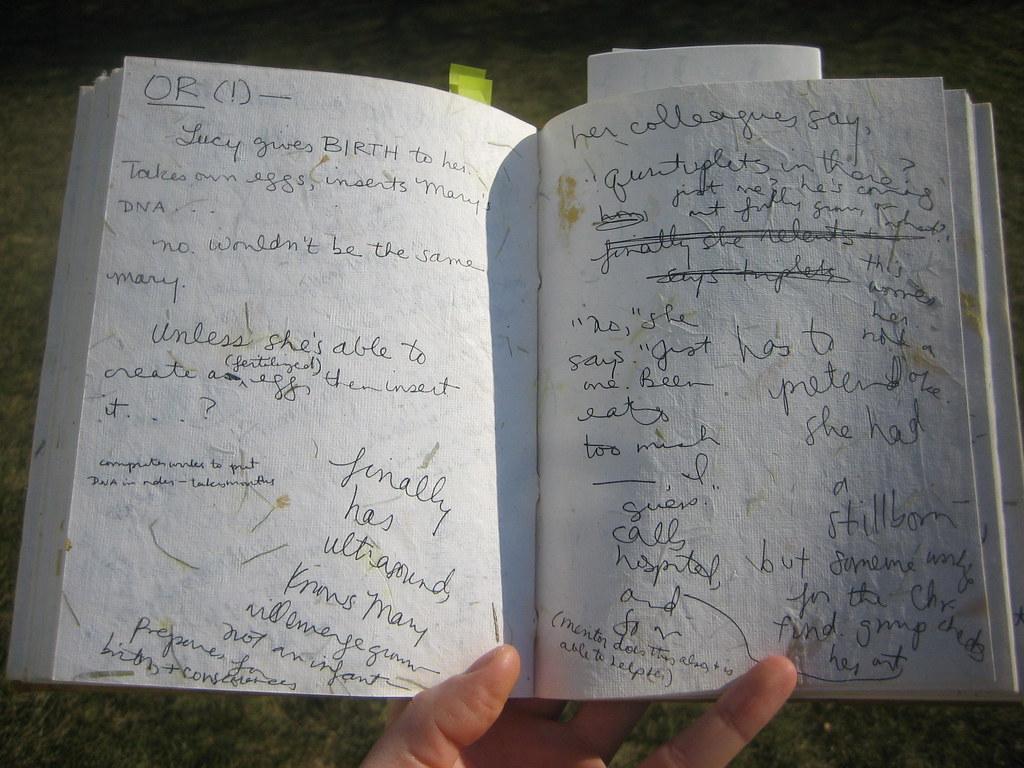
I was sorting through old journals recently, and found some very rough notes for Mary Modern taken before I even got to Galway.

(Better view here. Or just click on the photo.)

I thought it might be fun to put up a few pages to give you a glimpse of the story in its earliest stage of development. (I don't know about you, but I eat this stuff up.)

(Better view here.)

After all, you've got to start someplace...

Thursday, March 4, 2010

Dame Alice

(Here's a bit about the most famous Irish witch, Dame Alice Kyteler, adapted from a Moon Ireland sidebar.)

Easily the most colorful character in Kilkenny history, Dame Alice Kyteler was a businesswoman in the early 14th century who gained more money and power with each husband she acquired. There were four in all, and since each died under mysterious circumstances it was inevitable that Dame Alice should be accused of witchcraft. According to Peter Somerville-Large in Irish Eccentrics, Dame Alice allegedly led her coven in parodies of the Mass using dead men's fingernails and the shrouds of unbaptized boys. "She sacrificed nine red cocks and nine peacock's eyes to her incubus, Art, or Robert, who had carnal knowledge of her in the shape of a cat [or] a hairy black dog..."

Though formally charged in 1324, her influential friends (her brothers-in-law, mostly) had the offending bishop, Richard de Ledrede, imprisoned for seventeen days. The trial commenced upon his release, however, and Dame Alice and her servant girl, Petronilla, were sentenced to burn at the stake. Dame Alice fled the country the night before the execution, leaving loyal Petronilla to her fiery fate on the third of November, 1324. (Somerville-Large gives the 3rd of September, 1325 as the date of execution.)

Alice Kyteler's firstborn son, William Outlawe, agreed to give alms to the poor and re-roof the choir stalls at St. Canice's Cathedral to avoid the gallows. Dame Alice was never seen or heard of again.

If this story captures your imagination as it did mine, you'll want to hunt down a copy of Emma Donoghue's The Woman Who Gave Birth to Rabbits (Half.com link here). "Looking for Petronilla" is the best of the collection.

Monday, March 1, 2010

Great Book #45: Lord of the Flies

I somehow got out of reading this one in middle school Language Arts class, but I was always curious about it; Lord of the Flies is one of those novels nobody seems to like (or if they do they don't own up to it). It’s a shocking book, but what shocked me most was how much I enjoyed it. I listened to the audiobook narrated by the author, which is always a particular treat since you hear the story exactly as it was intended to be read.

Even if you haven't read this book you've probably heard how ugly it gets: English schoolboys plane-wrecked on a deserted island during World War II attempt to form a civilization, which quickly disintegrates. Ralph is focused on maintaining a signal-fire so they can be rescued, while Jack is only interested in hunting pigs and unseating Ralph as 'chief'. Jack succeeds in turning the rest of the 'tribe' against Ralph, and they literally begin to hunt him down like a wild animal.

It doesn't matter that how they came to be there—why all boys and no girls? evacuated from where, to where? None of the boys mention having been anywhere outside of England—is implausible, and the ending even more so. The boys' descent into savagery is horrifying because it is, for the most part, believable. On any school playground anywhere in the world you can witness myriad minor cruelties that, in the absence of adult supervision, could snowball all too easily; the innocence of childhood is just a veneer over our cruel primal instincts. Jack—what is he, twelve, thirteen?—uses the prospect of a phantom in the forest to rally the boys behind him, paints his face with pig's blood, and does not care that his obsessive ambition to lead the group results in at least two violent deaths. The fearmongering and the struggle for power, the mad despot, the merciless scapegoating and the torturing of anyone who dares to disagree...it all sounds awfully familiar.

Golding's prose can be, erm, too evocative (particularly when the boys go after a wild pig with bloodthirsty glee), but some of the descriptive bits are really splendid: "the lagoon attacked them with a blinding effulgence"; "a sudden communion of shining eyes in the gloom"; "the tree trunks and the creepers that festooned them lost themselves in a green dusk thirty feet above him". And it's not just the jungle atmosphere he nails: "Piggy sat expressionless behind the luminous wall of his myopia." I wonder if somebody with perfect eyesight could understand how apt that sentence is, because I sure do. (Poor Piggy! We never find out what his real name is.)

Golding begins and ends his recording with a conversational bit about how he came to write the book. He said he had to make the group boys only, because if it had been mixed the book would have had to be primarily about sex, and if it had been only girls they would have behaved a whole lot better and there wouldn't have been a story. I don't know about that—at times in my adolescence it certainly seemed like the cattiness of girls was a far more insidious thing than the boys' tendency towards violence and domination—but I did appreciate this: 'I think women are foolish to pretend they are equal to men. They are far superior, and always have been.' As my grandmother says: 'Amen, brother. Amen.'

Wednesday, February 24, 2010

Witchcraft versus Sorcery

Another tidbit from Peter Somerville-Large's Irish Eccentrics:
'The distinction between witchcraft and sorcery seems to be one of degree; sorcery is the more sophisticated pursuit, since its practitioners seem to be rather masters of the devil than his slaves. Of course, the advantage is only temporary.'
So remember that the next time a winged man-goat offers you wealth, success, and eternal life for a nominal fee.

[Woodcut from Life.com.]

Friday, February 19, 2010

Irish Saints and other Human Oddities

In the course of researching my new novel—(what a terrible thrill I just got when I typed that!)—I came across a delightful book called Irish Eccentrics by Peter Somerville-Large. The chapter on "Miracle Makers, Rhymers, Witches, Giants and Oddities" is especially weird and entertaining:

There were ten speckled saints and eleven leper saints. Others more fantastical had attributes connected with ancient fertility beliefs. Many were prolific, like the female saint, Darerca, who had seventeen sons and two daughters. The sons all became bishops while the daughters remained virgins. A bisexual like Mochue Cicheach had remarkable breasts which 'fed babies of future eminence.' Other saints had three and even four breasts. Others were odder still, like Fer Caille, who had buttocks like cheese, one arm and one leg and a long enough nose to be looped around the branch of a tree.

(No, I'm not making this up.)

More excerpts to follow...

Sunday, February 14, 2010

The Art of Kissing

"Arrange it so that the girl is seated against the arm of the sofa."

Back in high school I came across The Art of Kissing, a reproduction of a booklet first published in 1936, and seeing as it's Valentine's Day I thought I'd dust it off and blog about it. As the following passage will show, it has very little to offer in the way of practical advice:

"For a kiss can never be absolutely defined. Because each kiss is different from the one before and the one after. Just as no two people are alike, so are no two kisses alike. For it is people who make kisses. Real, live people pulsating with life and love and extreme happiness."

Gotta love that florid old-school prose, especially when applied to the subject of "osculations"; we are also provided with a very illuminating definition of the word tumescence. Every time I rediscover this book I wonder about the author, 'Hugh Morris.' Debonair man-about-town, or middle-aged pervert hunched over a typewriter in a terrycloth bathrobe? (Two guesses and the first doesn't count.)

"Different Sizes of Mouths Require a Different Technique in Kissing."

Morris quotes liberally from the love poems of Catullus, Horace, and somebody named Sir John Suckling, but as you might expect from a pamphlet published in 1936, misogyny is the overarching theme: "It is, therefore, necessary that the man be taller than the woman" because a man "must always give the impression of being his woman's superior, both mentally and especially physically."

(Good God, am I glad I was born at the right end of the twentieth century!)

It gets worse—the author stops just short of condoning out-and-out rape. "If she flinches, don't worry. If she flinches and makes an outcry, don't worry. If she flinches, makes an outcry and tries to get up from the sofa, don't worry. Hold her, gently but firmly, and allay her fears with kind, reassuring words. Remember what Shakespeare said about 'a woman's no!'"

Oh, but he's just warming up: "However, if she flinches, makes an outcry, a loud, stentorian outcry, mind you, and starts to scratch your face, then start to worry or start to get yourself out of a bad situation. Such girls are not to be trifled with...or kissed. It is such as they, in most cases, who still believe the story of the stork which brings babies because of the consequences of a kiss."

What an absurd little man you were, Hugh Morris! No doubt you concocted all this dangerous nonsense simply because every woman you encountered was much too smart to be snogging the likes of you.

I sat down to make fun of this thing and look what came out. Sorry about that. I think I'll go eat some candy hearts now.

(Thanks to eliz.avery on Flickr for scanning all the delightful illustrations. Check out her photostream, there's plenty more where that came from.)

Monday, January 25, 2010

Adventures in London, part 2

New Year's Day was pretty lazy—after hanging around Foyle's for awhile (Seanan was working), Deirdre and Diarmuid and I went to The George for some mulled wine. The building dates to the mid-1600s; Dickens drank there, and Shakespeare at an earlier tavern on the same site. Very quaint and surprisingly untouristy.

On the 2nd we went shopping at iKnit (Diarmuid was a real trooper) and Persephone Books, and eventually we got to the British Museum. I picked up some violet cremes (out of this world!!) at Hope & Greenwood to have at The Woman in Black, which was every bit as spooky as we hoped. Afterwards we met Seanan (who was just getting off work) and had a terrific dinner (with margaritas) at some Mexican place I can't remember the name of.

Above: a medieval grotesque at the British Museum.

Below: the main hall, and the Easter Island statue.


Deirdre and Diarmuid had to leave early on the 3rd, and Seanan was working, so I spent the day (mostly) browsing. There was yarn shopping—oh my, was there yarn shopping—and there was fabric, too, at the hallowed Liberty's, although I didn't end up buying anything because that place is so overwhelming it's impossible to make a decision!

Above: the Columbia Flower Market on a Sunday morning; graffiti art on the back of a truck at the Brick Lane market; Regent Street just before 5pm.

Thursday, December 17, 2009

Great Book #70: Suite Française

I remember the literary hubbub surrounding the English-language publication of Suite Française in the summer of 2006: the trade paperback was stacked on the front table of every bookstore I walked into, with that melancholy tinted black-and- white cover photo of a couple —in a crowded city square, a single suitcase at their feet—who clearly have no idea where they'll lay their heads tonight.

Irène Némirovsky was a Parisian Catholic (of Russian-Jewish extraction) who died at Auschwitz in August 1942 at the age of 39, and this unfinished novel wasn't discovered until the author's daughter started going through her notebooks in the 1990s. I've been listening to the audiobook while I knit, and I understand why the critics have called it a masterpiece: the prose is beautiful, clear and unaffected, and it's remarkable that Némirovsky could cast such cool, keen eye on something so horrible that was happening in real time—the story reads like it was written with the benefit of many years' hindsight.

Most of the characters are intensely unlikable, and in their flight from Paris they resemble rats on a sinking ship. Only the Michauds—humble, hardworking, and sick with worry over the fate of their son—are characters we can get behind. The Michauds are the only men in the book who don’t trample on others to save their own skins; unlike the other men, Maurice Michaud doesn’t consider himself irreplaceable.

Yet there are occasional moments of grace: a refugee crouching in a ditch during an air raid notices a white butterfly flitting among the wildflowers; a mother holds her child so tightly it seems as if she wants to put the baby back into her womb, the only safe place; a young woman tends to a wounded soldier during “the summer they were 20, in spite of everything.”

These moments are rare, however. The book is divided in two (the “suite” being unfinished): “A Storm in June” follows a bunch of miserly, hypocritical Parisian snobs as they flee the city, and “Dolce” observes a community of superstitious farm wives, including two young women locked into cold and loveless marriages. The novel’s prevailing attitude can be encapsulated by Hubert Péricand, who leaves his family a foolhardy teenager eager to see battle, and returns to them a cynical young man:
The people around him, his family, his friends, aroused a feeling of shame and rage within him. He had seen them on the road, them and people like them: he recalled the cars full of officers running away with their beautiful yellow trunks and their painted women, civil servants abandoning their posts, panic-stricken politicians dropping files of secret papers along the road, young girls, who had diligently wept the day the armistice was signed, being comforted in the arms of the Germans. “And to think that no one will know, that there were will be such a conspiracy of lies that all this will be transformed into yet another glorious page in the history of France. We’ll do everything we can to find acts of devotion and heroism for the official records. Good God! To see what I've seen! Closed doors where you knock in vain to get a glass of water and refugees who pillaged houses; everywhere, everywhere you look, chaos, cowardice, vanity and ignorance! What a wonderful race we are!”
Living (and dying) the way she did, witnessing all that she did, it’s no wonder Némirovsky’s characters are either selfish bastards or misanthropes. From the preface to the French edition: "She had absolutely no illusions, not about the attitude of the inert French masses—'loathsome' in their defeat and collaboration—nor about her own fate." She refused to stop writing even when the rest of the French publishing industry were rolling over for the Nazis, and she knew they would eventually murder her for it.

There is a violent act towards the end of "A Storm in June" that disturbed me so much I had to stop listening for a couple of months (I started the book in early October). I don't want to tell you what happened that so turned my stomach, in case this novel is on your list, but suffice it to say my mother will not be reading Suite Française. The passage in question is one of the most shocking things I have ever read.

I get that war is hell and it brings out the very worst in people, but doesn’t it also, if only occasionally, bring out the very best? There were plenty of people who didn’t wish to survive at the cost of their humanity; not every person in France was apathetic, not everyone was a collaborator; just because the word “heroism” is grossly overused doesn’t mean there are no heroes. We see virtually none of that in Suite Française because that wasn't the author's experience; but I imagine it's rather difficult to give your characters a happy ending when you know your own will be anything but.

Wednesday, December 16, 2009

Patternmaking with Cal Patch

I'm trying to improve my sewing skills, so to that end I signed up for a patternmaking workshop at the Brooklyn General Store last Sunday. There wasn't actually any sewing involved (yet)—you take your own measurements and plot them on newsprint paper to make a pattern for a jersey t-shirt. As it turned out, I was the only person who showed up for the class, so I basically got a private lesson with the marvelous Cal Patch.

Cal has recently published Design-It-Yourself Clothes: Patternmaking Simplified, which I really wanted to buy on the spot, but I must sheepishly confess that I can't bring myself to pay full price for a book when I can get a discount online. (Cal is totally cool with this, and she feels the same way; authors receive the same percentage whether you pay the list price or get 40% off. It turns out we're both published by Crown/Random House, and we talked about how the titles on the Potter Craft list have gotten much better in the last couple of years. Her book being proof of that, of course!) I'm planning to use some of my Christmas loot to order myself a copy.

Her book is full of patterns that are fresh and modern without being trendy, and they're designed so you can easily modify them to suit your own taste and measurements. It was raining hard when we left Brooklyn General, but I was feeling really cheerful and inspired despite having no umbrella. Cal is a great teacher, and I highly recommend taking a class with her.