Something really crappy happened in the publishing world last week.
Let me back up. From the day I got my Mary Modern book deal (14 March 2006—can't ever forget a date that important), I felt really happy to be a part of Shaye Areheart Books. Shaye and Sally (my editor on Mary Modern) always made me feel not only that they loved my book, but that they cared about me personally. I got the impression that it wouldn't make one bit of difference to Shaye if I never made a bestseller list, so long as I kept telling good stories.
Now, this sort of thing happens quite a bit—CEOs and other folks in lofty positions occasionally get ousted in publishing just like any other business—and I don't want this to turn into an anti-corporate rant or anything. (Well, all right: I composed the rant, and have just hit 'delete'.) I just wanted to ask that when you pick up a hardcover copy of Petty Magic this fall, stop and look at the colophon on the spine. It ought to have been a steaming coffee cup, with SHAYE AREHEART BOOKS written underneath.
Showing posts with label mary modern. Show all posts
Showing posts with label mary modern. Show all posts
Wednesday, May 5, 2010


Tuesday, March 16, 2010
Process, part 2
(Process, part 1.)
Here's a page from one of my NUIG notebooks. People always seem surprised that I don't write in chronological order, but to me it makes sense (during the rough draft, once the thing has been loosely plotted) to write whichever scene I feel like writing, and stitch them together afterward.

(Click here for a better view.)
In this case, I'd only just started the draft in earnest (notice the date up top: 6 October 2004), but I was already working on the graveyard scene that begins on page 218. Some famous writer said that if you know how your novel is going to end before you've written it, then it isn't worth writing at all. Biggest load of baloney I ever heard.
Here's a page from one of my NUIG notebooks. People always seem surprised that I don't write in chronological order, but to me it makes sense (during the rough draft, once the thing has been loosely plotted) to write whichever scene I feel like writing, and stitch them together afterward.
(Click here for a better view.)
In this case, I'd only just started the draft in earnest (notice the date up top: 6 October 2004), but I was already working on the graveyard scene that begins on page 218. Some famous writer said that if you know how your novel is going to end before you've written it, then it isn't worth writing at all. Biggest load of baloney I ever heard.
Tuesday, March 9, 2010
Process
I was sorting through old journals recently, and found some very rough notes for Mary Modern taken before I even got to Galway.
 (Better view here. Or just click on the photo.)
I thought it might be fun to put up a few pages to give you a glimpse of the story in its earliest stage of development. (I don't know about you, but I eat this stuff up.)
 (Better view here.)
After all, you've got to start someplace...
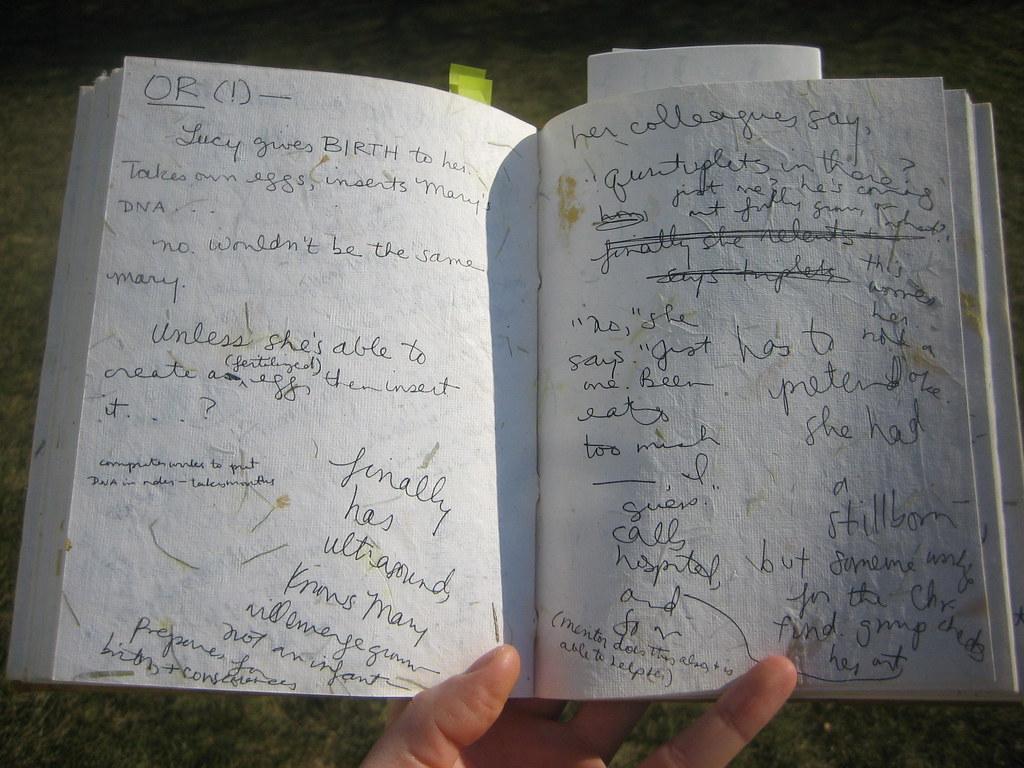 (Better view here. Or just click on the photo.)
I thought it might be fun to put up a few pages to give you a glimpse of the story in its earliest stage of development. (I don't know about you, but I eat this stuff up.)
 (Better view here.)
After all, you've got to start someplace...
Friday, September 25, 2009
The day I became a writer
It was May 1, 1996. My 9th-grade English teacher, Mrs. Gaffney, was out sick, and the substitute brought us to the library and told us our assignment was to pick one of the prints on the walls above the bookcases and write a story about it. It was busy work, but an easy 20 out of 20. I chose a picture of an old farmhouse at dusk, and decided to write a story about a girl listening to her grandmother telling stories on a porch in the twilight—the time of day being, of course, a metaphor as light as an anvil.
At the time my grandmother was very, very sick, but I wasn't thinking much about her as I wrote. This was fiction. Where my narrator's grandma told fanciful stories that made her granddaughter doubt if she was 'all there,' mine was still living very much in the present—and was as reluctant as ever to tell any stories about her life. Why did I write that stupid story instead of actually calling my grandmother to tell her I loved her? It was the last night I'd ever have the chance to do it.
But I didn't. I printed the two-page story, tucked it in my notebook, and turned it in to Mrs. Gaffney the following day. And that afternoon, on May 2nd, my grandmother passed away.
A few days later—I can't remember if it was before or after the funeral, which was on May 5th—my teacher passed back our graded writing assignments. I had forgotten all about it, of course, but I felt sick when I remembered what I'd written. The horrible irony of it!
But as if that wasn't bad enough, there was a secondary indignity that pretty much lit the fire under me: Mrs. Gaffney had given me an 18 out of 20. An A-. Mind you, this was the type of assignment we always got 20 out of 20 on. And mind you, I wouldn't have cared if this had been any other day, or any other assignment. I went up to her after class and asked her why she'd given me a lower grade, and she said something to the effect of creative writing being subjectively graded (looking at the print-out right now, it occurs to me that it might have had something to do with the obnoxious font I used). Anyway, I don't think I told Mrs. G. the real reason why I was so upset (there were a ton of overachievers at Mo-town, so complaining about A-minuses happened all the time), but when I got home that night I opened a new word processing document and typed, "I'm going to show Mrs. Gaffney! I'm going to be a writer."
And I did show Mrs. Gaffney, who hightailed it home from her golf tournament one day in July 2007 to hear me read from Mary Modern at the local Barnes & Noble. I've never told her what a big part she played in making me a storyteller, but there it is.
At the time my grandmother was very, very sick, but I wasn't thinking much about her as I wrote. This was fiction. Where my narrator's grandma told fanciful stories that made her granddaughter doubt if she was 'all there,' mine was still living very much in the present—and was as reluctant as ever to tell any stories about her life. Why did I write that stupid story instead of actually calling my grandmother to tell her I loved her? It was the last night I'd ever have the chance to do it.
But I didn't. I printed the two-page story, tucked it in my notebook, and turned it in to Mrs. Gaffney the following day. And that afternoon, on May 2nd, my grandmother passed away.
A few days later—I can't remember if it was before or after the funeral, which was on May 5th—my teacher passed back our graded writing assignments. I had forgotten all about it, of course, but I felt sick when I remembered what I'd written. The horrible irony of it!
But as if that wasn't bad enough, there was a secondary indignity that pretty much lit the fire under me: Mrs. Gaffney had given me an 18 out of 20. An A-. Mind you, this was the type of assignment we always got 20 out of 20 on. And mind you, I wouldn't have cared if this had been any other day, or any other assignment. I went up to her after class and asked her why she'd given me a lower grade, and she said something to the effect of creative writing being subjectively graded (looking at the print-out right now, it occurs to me that it might have had something to do with the obnoxious font I used). Anyway, I don't think I told Mrs. G. the real reason why I was so upset (there were a ton of overachievers at Mo-town, so complaining about A-minuses happened all the time), but when I got home that night I opened a new word processing document and typed, "I'm going to show Mrs. Gaffney! I'm going to be a writer."
And I did show Mrs. Gaffney, who hightailed it home from her golf tournament one day in July 2007 to hear me read from Mary Modern at the local Barnes & Noble. I've never told her what a big part she played in making me a storyteller, but there it is.
Wednesday, June 25, 2008
Mary Modern now out in paperback!
 I almost wet myself with excitement the day my editor emailed me the new paperback cover. Isn't it incredible? The über-talented Dan Rembert designed both covers, but he really outdid himself with the re-design. You can't see it too well in the jpeg, but those faint horizontal lines are DNA code. Captures the quirky spirit of the book just perfectly.
At the back of the book you'll find a reading group guide as well as an author essay written especially for the paperback edition. I wrote about how this photo of my great-grandparents sparked the idea.
Hard to believe it's been a year since the novel came out. I'm trying not to think about how well the paperback will end up selling, and actually, it isn't all that hard when my head is so full of plot lines and bits of dialogue from Petty Magic...
Sunday, June 15, 2008
Thoughts on Criticism and Rejection
Rejection is hard. It gets a little easier as you go on, but not by much. The sooner you start to devise little coping strategies to keep your ego patched, the better off you'll be.
Whenever I got to feeling down over a rejection (or, later on, a snarky Amazon review), I thought: Well, the person who is criticizing me [an editor, reviewer, or random reader] can’t do what I’m doing--they don’t have the guts, or the talent, or either of the two. This may sound snarky in its own right, and maybe it is. It also isn’t fair to all those wonderfully talented editors and agents out there, those midwives and shepherds of the literary world. Then again, I’ve found that the most talented editors and agents in the business do not write rejection letters that leave you feeling like a sack of elephant crap. Those are the letters--tactful, and sometimes even very encouraging--that spur you on.
This attitude I’m talking about--THEY can’t do it and therefore I should take their criticism with a grain of salt--is merely a coping strategy. I'm not talking about the criticism that you know in your heart is wise and right on the money. This is just something to keep in mind when you start feeling like you’ve seriously overestimated your own talent. Even if you’ve written the sloppiest, most derivative novel ever put to paper, a manuscript that will never see publication, you’ve still accomplished more than most folks ever do.
I'm not discounting the job of reviewers. Literary criticism is as necessary as literature itself, and can be every bit as enjoyable to read. It just drives me nuts when I read a snarky review. It's like when a reviewer takes pains to include some line about Mary Modern not holding a candle to the original Frankenstein. First of all, it's NOT Frankenstein, nor is it a retelling. Nobody was claiming on the dust jacket or marketing materials that I wrote an instant classic. It comes off sounding like a jab, and it's completely unnecessary. In another case, a reviewer dismissed my characters as ciphers--never mind that I can tell you every character in that book is based on a person (or, more often, a series of people) I've known in real life. As I read that particular review, it was abundantly clear that the reviewer had decided not to like my book before he even cracked the spine.
You definitely start to sense a bit of envy between the lines of these reviews sometimes. Perhaps the reviewer is himself a frustrated fiction writer, so he says your work is derivative, mediocre, or what have you. Mind you, I'm not whining or being underhandedly smug here--I'm saying this because I often felt this impulse myself before I was published. I have taken notice of several literary catfights in recent years, most memorably between Laura Miller of Salon.com and the novelist Chuck Palahniuk. She wrote a review of Diary in 2003 that was so unbelievably negative it was downright undignified, and he responded with a letter to the editor that had me jumping with glee:
(By the way, I haven't read any of Mr. Palahniuk's novels, but I don't care if Diary was the worst piece of tripe published in this or any other century; nothing could justify the writing of probably the nastiest, snarkiest piece of "journalism" I have ever read. Even this Salon critic's less controversial columns have really annoyed me from time to time--like when she dismissed David Mitchell's Cloud Atlas--which is an utterly sublime novel--as an albeit-fun pastiche. She's sounding more and more like a frustrated novelist, eh?)
Anyway, the upshot of all this is that one must read a book review with a critical eye. Sometimes reviewers are needlessly harsh for reasons that have more to do with them than the author, and sometimes there are good reviews of mediocre books written by acolytes. Sometimes there are reviews of books by great writers that are criticized by novelists whose work is patently inferior, or a novelist who is insecure about her own place in the literary canon and acts on an urge to cut down a fellow author. And sometimes, once in a blue moon it seems, there's a thoughtful review written by someone with no angle at all.
But that's not the real reason I've stopped reading book reviews. The real reason is that avoiding them is another coping strategy for me--otherwise I'd be reading glowing reviews of books with rehashed plots thinking, Damn it, why did this newspaper ignore my book? Also, I stopped reading the Amazon/Librarything/whatever reviews not too long after Mary Modern was published. There are some really ridiculous ones out there--there's at least one two-star review that spells my name "Deangeiiis," and says my book was poorly edited without even bothering to make a logical case for the assertion. WHO takes these people seriously? Who? Not me, that's who--those crappy, illogical, useless reviews can only raise my blood pressure.
Whenever I got to feeling down over a rejection (or, later on, a snarky Amazon review), I thought: Well, the person who is criticizing me [an editor, reviewer, or random reader] can’t do what I’m doing--they don’t have the guts, or the talent, or either of the two. This may sound snarky in its own right, and maybe it is. It also isn’t fair to all those wonderfully talented editors and agents out there, those midwives and shepherds of the literary world. Then again, I’ve found that the most talented editors and agents in the business do not write rejection letters that leave you feeling like a sack of elephant crap. Those are the letters--tactful, and sometimes even very encouraging--that spur you on.
This attitude I’m talking about--THEY can’t do it and therefore I should take their criticism with a grain of salt--is merely a coping strategy. I'm not talking about the criticism that you know in your heart is wise and right on the money. This is just something to keep in mind when you start feeling like you’ve seriously overestimated your own talent. Even if you’ve written the sloppiest, most derivative novel ever put to paper, a manuscript that will never see publication, you’ve still accomplished more than most folks ever do.
I'm not discounting the job of reviewers. Literary criticism is as necessary as literature itself, and can be every bit as enjoyable to read. It just drives me nuts when I read a snarky review. It's like when a reviewer takes pains to include some line about Mary Modern not holding a candle to the original Frankenstein. First of all, it's NOT Frankenstein, nor is it a retelling. Nobody was claiming on the dust jacket or marketing materials that I wrote an instant classic. It comes off sounding like a jab, and it's completely unnecessary. In another case, a reviewer dismissed my characters as ciphers--never mind that I can tell you every character in that book is based on a person (or, more often, a series of people) I've known in real life. As I read that particular review, it was abundantly clear that the reviewer had decided not to like my book before he even cracked the spine.
You definitely start to sense a bit of envy between the lines of these reviews sometimes. Perhaps the reviewer is himself a frustrated fiction writer, so he says your work is derivative, mediocre, or what have you. Mind you, I'm not whining or being underhandedly smug here--I'm saying this because I often felt this impulse myself before I was published. I have taken notice of several literary catfights in recent years, most memorably between Laura Miller of Salon.com and the novelist Chuck Palahniuk. She wrote a review of Diary in 2003 that was so unbelievably negative it was downright undignified, and he responded with a letter to the editor that had me jumping with glee:
I have never responded to a review, perhaps because I've never gotten such a cruel and mean-spirited one.Please send me a copy of your latest book. I'd love to read it.
Until you can create something that captivates people, I'd invite you to just shut up. It's easy to attack and destroy an act of creation. It's a lot more difficult to perform one. I'd also invite you to read the reviews Fitzgerald got for "Gatsby" from dull, sad, bitter people -- like yourself.
Amen, Chuck.
(By the way, I haven't read any of Mr. Palahniuk's novels, but I don't care if Diary was the worst piece of tripe published in this or any other century; nothing could justify the writing of probably the nastiest, snarkiest piece of "journalism" I have ever read. Even this Salon critic's less controversial columns have really annoyed me from time to time--like when she dismissed David Mitchell's Cloud Atlas--which is an utterly sublime novel--as an albeit-fun pastiche. She's sounding more and more like a frustrated novelist, eh?)
Anyway, the upshot of all this is that one must read a book review with a critical eye. Sometimes reviewers are needlessly harsh for reasons that have more to do with them than the author, and sometimes there are good reviews of mediocre books written by acolytes. Sometimes there are reviews of books by great writers that are criticized by novelists whose work is patently inferior, or a novelist who is insecure about her own place in the literary canon and acts on an urge to cut down a fellow author. And sometimes, once in a blue moon it seems, there's a thoughtful review written by someone with no angle at all.
But that's not the real reason I've stopped reading book reviews. The real reason is that avoiding them is another coping strategy for me--otherwise I'd be reading glowing reviews of books with rehashed plots thinking, Damn it, why did this newspaper ignore my book? Also, I stopped reading the Amazon/Librarything/whatever reviews not too long after Mary Modern was published. There are some really ridiculous ones out there--there's at least one two-star review that spells my name "Deangeiiis," and says my book was poorly edited without even bothering to make a logical case for the assertion. WHO takes these people seriously? Who? Not me, that's who--those crappy, illogical, useless reviews can only raise my blood pressure.
Tuesday, May 6, 2008
A little fish meets a Big Fish
 [Haven't forgotten to write about Cúirt. Next time!]
I want to tell you a really cool story that begins more than four years ago now. My father handed me the USA Today books section and pointed to this article about novelist Daniel Wallace and Big Fish. In the interview, Mr. Wallace expresses amazement at the eventual runaway success of his novel, and talks about how much he enjoyed his cameo in Tim Burton's big screen adaptation. I had seen the film with my father and we both enjoyed it very much.
But the real reason he pointed me to the article was this: Mr. Wallace told the interviewer he had written five novels before Big Fish, all of which had been rejected by publishers. At the time, my Practice Novel was generating quite a high stack of rejection letters and I was feeling depressed about it. My dad told me to take heart, that perseverance would eventually bring success, and this article was proof of it. At first I thought, "I think I can write one more novel, and if that novel is rejected, then I'm at the end of my rope." Then I thought, "If Daniel Wallace can write five novels and break out with the sixth, then maybe I can too." Anyway, I stuck with it, and Novel #2 turned out pretty well for me (tee hee). When I gave advice to other writers, I always emphasized perseverance--precisely because of this USA Today article and Daniel Wallace's story.
Fast forward to October 2007. I'd published Mary Modern a few months back and now I was on my way to the Midwest Literary Festival, my first ever (and let me tell you, I was so excited). Daniel Wallace was also attending, though I didn't expect I'd get the opportunity to thank him for his inspiration. I'd be too intimidated, anyway. Well, I actually did meet Daniel Wallace in the backseat of a van on our way to the authors' welcome barbecue, but I, ever-clueless, had it in my head that this guy whose hand I'd just shaken was a literary agent (in fairness, he was only introduced to me as "Dan"). Anyway, I eventually realized who he was, and wondered if I'd be able to talk to him, though I was still feeling a little intimidated. (There were so many established writers at this festival that it was hard not to feel a little mouse-like at first, though I quickly relaxed when I realized just how nice and down-to-earth they all were.)
On the last day of the festival, they had scheduled me for a panel discussion that was going to end right around the time I needed to be taking a car back to the airport. I booked it out of the conference center and down a few blocks back to the hotel to pick up my bags. When I got there, I saw the appointed Lincoln town car, and then I saw Daniel Wallace right beside it. We were going to be sharing a ride to the airport! I couldn't believe the serendipity of it.
As I loaded my bags he said something to the effect of, Are we going to have a chat? I'd like to have a chat but if you'd rather not I just want to know in advance. SO NICE! Of course I want to have a chat, I said. So on the way to the airport I told him the story I've just told you, about how much that USA Today article meant to me. He actually seemed rather taken aback--he is just such a genuinely humble guy. I said, "If my dad had pointed to that article and said, 'Three and a half years from now you'll be riding in the backseat of a Lincoln town car with Daniel Wallace, talking about your publishers and teaching creative writing classes,' I would never have believed him."
So that's my little story of how perseverance pays off.
Thursday, February 7, 2008
Post #3 weeeeeeeeeeeeee!
I do sometimes worry about offending people though. The character I am channeling right now is bawdy and outspoken, and behaves in ways I would absolutely never. I make a brief foray into the so-called decadence of 1920s Berlin, and so my character refers to “sipping pink champagne with kohl-eyed nancies.” Politically incorrect epithet aside, my stepsister’s name is Nancy. Will she be offended?, I wondered as I wrote that line. I have a line about a town called Harveysville and how it sounds like “a hamletful of inbreds.” There may be dozens of Harveysvilles across the country. If any of their inhabitants pick up this novel, will they be offended? I think about things like this as I write—along with the inescapable squirminess of making sexual references knowing my grandparents are someday going to read it—but in the end I know I have to ignore these worries or the story’s integrity will suffer. That might sound a little pretentious, but what’s the point in writing this character’s story if I’m going to censor it? The new novel is written in the first person, and when a story is written in the first person you’ll inevitably have some readers who think your beliefs are synonymous with your character’s. Heck, they’ll think so even if you write in the third person.
While we’re on the subject of offending people, I might as well note that it seems I have offended a few Republicans who didn’t like the fact that one of the main characters in Mary Modern is a scientist who is vehemently anti-Bush. (She’s from a clan of Massachusetts Catholics, so it’s no real shocker, is it?) My editor and I did discuss toning down the liberal rhetoric in the novel, but ultimately I decided to follow my own character’s advice: “Life is too short for subtlety.” I noticed a review on Amazon that said this lack of subtlety “took the shine off a bit” from an otherwise fine novel, and that criticism is perfectly valid. But when people say my novel is “bad” just because they don’t agree with my characters’ political beliefs, well…that seems rather ignorant.
So I’m not going to worry about offending people—or at least I’ll try not to!
While we’re on the subject of offending people, I might as well note that it seems I have offended a few Republicans who didn’t like the fact that one of the main characters in Mary Modern is a scientist who is vehemently anti-Bush. (She’s from a clan of Massachusetts Catholics, so it’s no real shocker, is it?) My editor and I did discuss toning down the liberal rhetoric in the novel, but ultimately I decided to follow my own character’s advice: “Life is too short for subtlety.” I noticed a review on Amazon that said this lack of subtlety “took the shine off a bit” from an otherwise fine novel, and that criticism is perfectly valid. But when people say my novel is “bad” just because they don’t agree with my characters’ political beliefs, well…that seems rather ignorant.
So I’m not going to worry about offending people—or at least I’ll try not to!
Subscribe to:
Posts (Atom)
