Showing posts with label wwii. Show all posts

Thursday, July 22, 2010

Operation Mincemeat

World War II offers us far more interesting, amusing and subtle examples of intelligence work than any writer of spy stories can devise.
—Admiral John Godfrey

In Petty Magic, I refer to a couple of the most spectacular World War II hoaxes, both of which were part of a larger deception plan, Operation Barclay—constructing sham army camps to fool Nazi reconnaissance, and planting phony intelligence documents on a corpse in uniform. It took several incredibly imaginative, 'corkscrew-minded' intelligence officers to hatch each of these plots, and in my novel I give all the credit to my magician-spy, Neverino. These hoaxes were first devised not by a magician, but a novelist!

The hoax involving a corpse in uniform was codenamed Operation Mincemeat (Churchill had forbidden the use of obvious or jokesy code names, but apparently no one listened to him), and it's the subject of a riveting new book by British journalist Ben Macintyre.

To begin regaining control of Europe in the summer of 1943, the Allies first needed to take back Sicily—and the Germans were just as aware of its strategic importance. Taking advantage of Hitler's 'Balkan fixation' (because the Third Reich got most of its raw materials from Romania, Bulgaria, and Yugoslavia), the Allies would convince him that they were planning to invade Sardinia and Greece instead, and that Sicily was the phony target.

Human agents or double agents can be tortured or turned, forced to reveal the falsity of the information they carried. A dead body would never talk.

So here's the gist: the corpse-with-phony-identification idea originated in Basil Thomson's novel, The Milliner's Hat Mystery, published in 1937. Ian Fleming, the naval intelligence officer who would later pen the James Bond novels, was a fan of Thomson's, and he included it in the "Trout Memo," a list of possible hoaxes that was distributed among the intelligence chiefs at the very beginning of the war. Two other officers in MI5—the eccentric, unassuming Charles Cholmondeley ("Chumly") and the supremely confident lawyer Ewen Montagu—developed the idea and saw it to fruition.

Once the higher-ups at MI5 consented to the ruse, these two officers embarked on an elaborate planning process. St. Pancras coroner Bentley Purchase informed them that the body of a homeless Welshman, Glyndwr Michael, had just been brought in, and Cholmondeley and Montagu spent the next couple of months (with Michael in deep refrigeration) inventing his alter-ego, Major William Martin, complete with love letters and photographs, hotel bills, and snippy missives from his father and bank manager. Cholmondeley and Montagu spent so much time inventing him that they began to feel as if Martin had actually been a friend of theirs.

Cholmondeley, Montagu, and the other planners knew how the Nazis thought—their two biggest flaws (with regard to military intelligence and espionage, anyway) being 'wishfulness and yesmanship'—and if they could allow those phony documents to fall into the right hands, thousands of lives would be saved on both sides.

The operation got off as planned, and by the time 'Major Martin' arrived in Huelva, Spain, he stunk so bad the local forensic pathologist dismissed the inevitable anomalies (the corpse's face and the face on his ID card didn't quite match up; the body was too decomposed to have been in the water only a few days, as his documents attested) in favor of getting the heck out of the room. The body was laid to rest in a Catholic cemetery, and the suitcase and its contents got lost in a maze of Spanish bureaucracy and intrigue before the Nazis finally got their hands on it. The rumor of a Greek invasion spread, and thus began to substantiate itself; Hitler was convinced, and the ruse was complete.

The material is fascinating regardless, but Macintyre does a great job of bringing to life each character involved in the plot of Operation Mincemeat—from the aforementioned jolly coroner of St. Pancras ('He loved Gilbert and Sullivan operas, toy trains, boiled eggs, and his model piggery in Ipswich. He never wore a hat and laughed loudly and often') to the brave submarine commander assigned to the dispatch of 'Major William Martin', Bill Jewell, who only begins to fear for his life after falling in love with a Wren in Algiers. We get a keen sense of each player's desires and ambitions, their private histories and their miserable working conditions.

So why are so many details of the planning of Operation Mincemeat only now coming to light? After the war was over, there was still the possibility of a political backlash were the full story of the hoax to come out. British diplomats had conspired to deceive Spanish officials, so the revelation would have no doubt damaged Anglo-Spanish relations; furthermore, back at home, those who had orchestrated Operation Mincemeat had obtained the corpse by not-strictly-legal means, and exposure would have caused quite a bit of trouble for the coroner and other government offices involved in that particular aspect of the deception.

So, in The Man Who Never Was and on the international lecture circuit, Ewen Montagu spent forty years telling a story that was hopelessly incomplete—for the above reasons, and because Cholmondeley and several others abided by their MI5 oaths of secrecy for the rest of their lives. Macintyre had access to Montagu's personal archives, and along with information that has become available only in the last twenty years or so, he was able to write the most complete account of Operation Mincemeat we'll probably ever have. Its unputdownability is a testament to Macintyre's prowess as a storyteller. Highly, highly recommended.

[Edit: Since I wrote this I found there's another book on the subject that's also come out this year called Deathly Deception: The Real Story of Operation Mincemeat by Denis Smyth. It'd be interesting to compare them.]

Monday, May 31, 2010

Monday, May 17, 2010

'Home is the sailor, home from the sea.'

My grandpa Ted passed away this afternoon. He was ninety, and hadn't been well in quite awhile, but it still came as a bit of a shock. You know how, when you're little, you think your parents are invincible? That's how I'd always felt about Grandpa Ted.

(With his father and four of his six sisters. Thanks to our cousin Paula for this picture.)

During the war my grandfather was a petty officer aboard a destroyer in the South Pacific. He went for more than a year without setting foot on land, and that was the easy part—he'd survived kamikazes and two typhoons, during which the temperature in the engine room reached 180º F. When he got back to the States, he spent nearly a year convalescing in naval hospitals; for the rest of his life he dealt with some serious medical problems as a result of war-related injuries, and yet he always seemed to defy everybody's expectations. (Just to give you an idea, today he received Last Rites for the fifth time.) He never thought he'd live to see ninety; I sometimes joked he'd outlive us all.

(Summer 2005. This is how I want to remember him—robust, striding around the block in his Abercrombie & Fitch ballcap and t-shirt.)

(At the Mary Modern launch party with Grandpa Ted, Grandmom Kass, and Grandpop Mike, July 2007.)

We didn't always agree—heck, that feels like an understatement, given our diametrical political beliefs—but he was a good man, and I loved him very much.

(Two pics from summer '06, with kids and grandkids.)

I want to tell you the story of how my grandparents met. At the naval hospital in San Diego, they told him they were sending him home to New York for his big operation, and gave him a choice between hospitals in Queens (St. Albans) and Brooklyn. He knew that St. Albans was the newer hospital, and naturally he wanted to be treated at the best facility available. He opened his mouth fully intending to say “St. Albans,” but “Brooklyn” is what came out. If he’d chosen the hospital in Queens he would never have met my grandmother.

She was a lovely 23-year-old volunteer social worker, midway through an M.S.W. she would never complete. Sitting up in bed, he’d strain for a glimpse of her as she passed by his room. So he could speak to her, he kept asking for another pack of playing cards, and she asked him tartly how he could possibly lose so many decks. He wore her down, of course, and they married seven months later.

I've always been fascinated with this story for that one inexplicable slip of the tongue. Thank you, thank you, thank you for choosing Brooklyn, Nonno.

(What's even more uncanny is that she wasn't supposed to be in Brooklyn either—she'd been assigned to a hospital in Trenton, but another volunteer, who'd been assigned to Brooklyn, asked my grandmother to switch so she could be close to her family. My grandmother agreed, even though Trenton offered free housing and Brooklyn did not. She was that nice.)

I'm so glad I got the chance to sit down with Grandpa Ted while he was still in good health and ask him about his childhood in Italy and his life during the war. I've been meaning to edit the raw audio and put all the stories on CD. Now would be a good time, eh?

(Outside the Brooklyn Naval Hospital, sometime in 1947.)

Home is the sailor, home from the sea. (I think I like the A.E. Housman version better than Stevenson's.)

[Note on 19th May: I have made a few edits to the above for historical accuracy—after talking to my aunt Eileen and listening to the stories we recorded in 2007, I realized I'd made a few mistakes.]

Monday, December 22, 2008

Adventures in Germany: Ottobeuren

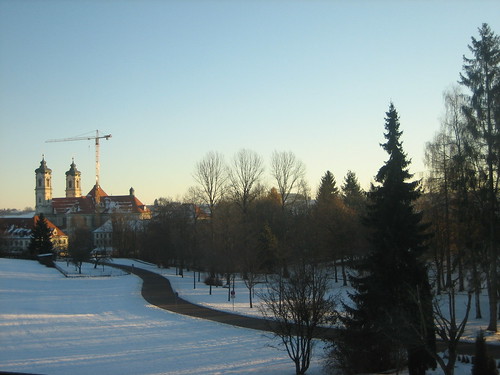
My first stop in Bavaria was a little town called Ottobeuren, known for its huge Benedictine monastery. Here's an early-morning view of the basilica from my hotel window:


There are a couple reasons why I came here. I first heard about Ottobeuren while listening to A Spy at the Heart of the Third Reich: the most valuable Allied spy of World War II, Fritz Kolbe, stayed here for a few days and was able to photograph his documents in the perfect privacy of the monastery library. (The narrator pronounced it Ott-oh-byur-in, but the bus driver didn't understand me when I pronounced it that way. Apparently it's Ott-oh-bway-rin.)

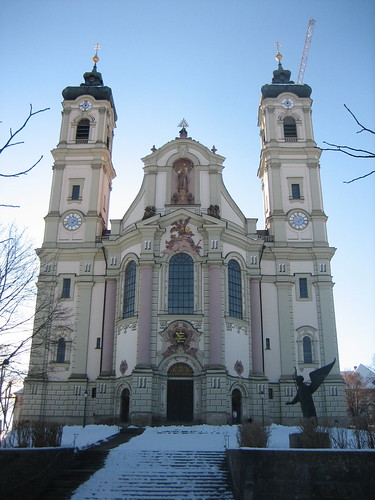
Anyway, I was intrigued by the monastery's description in the book, and when I googled it, I found another item of interest in the basilica: the complete skeletons of four obscure saints reclining in glass coffins, plus a lot of skulls and other bones in smaller glass cases (the skull of Saint Apollonia, for instance, is crowned with a wreath of jewels). Check out what's left of Saint Maurus below:


I know, it's not a very detailed photograph, but I couldn't bring myself to take any pictures at close range. These glass coffins were horrifying and wonderful all at once. It made me wonder who had exhumed these early saints, wired their bones together, and dressed them in velvet so they could be displayed like this.

According to the website, the monastery library and museum should have been open, but the door was locked and I was too timid to ask the lady at the gift shop if she spoke English. The sign said both gift shop and museum were closed for lunch, but lunchtime was over by the time I visited. I really should have asked, so that at least I would have known for sure that the museum was closed for the winter (or perhaps because of the construction). This is something I struggle with when I travel—this ridiculous timidity. I've come all this way...why not stick out my neck just a little bit further?

Otherwise, Ottobeuren is a quiet, pleasant little town with a few spa-hotels. I was a bit taken aback when I checked my credit card bill to find my stay at the Hotel St. Ulrich was listed as "SANATORIUM OTTOBEUREN"! My room was adorable and cozy, and because I only really came to check out the church and monastery (and there wasn't much else to do anyway), I ended up spending quite a bit of time curled up with my laptop. It was a very productive trip.

Here's a little shrine to St. Ulrich on the path from the church to the hotel:

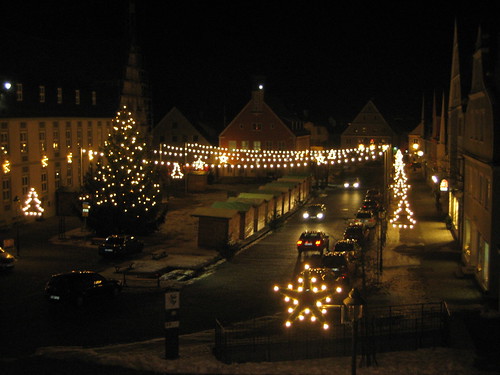
And here's Ottobeuren's Marketplatz by night:

My time here was wonderfully relaxing, and it was really neat to be able to walk the halls Fritz Kolbe walked sixty-odd years ago. I'm not sure yet how the visit will inform my fiction, but it certainly will somehow.

Next post: Nuremberg and more pictures of the Christkindlesmarkt!

Monday, November 3, 2008

Adventures in Germany: Quedlinburg

After three nights in Wernigerode, Kelly and I made an afternoon stop at Quedlinburg on our way back to Berlin. This town on the north-eastern edge of the Harz was one of the reasons I had wanted to come to Germany in the first place. I was struck by this passage in Resisting Hitler, a biography of the American scholar, communist, and German resistance member Mildred Harnack-Fish:
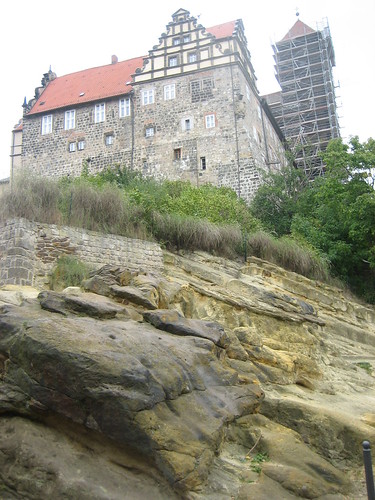
A romantic and evocative region abounding in medieval cathedrals and squares, the Harz has many literary associations, particularly with Heine and Goethe. On a postcard to Falk, Mildred wrote that "the beauty of the mountains, the rivers and forests under the great sun is powerful...Every evening we read Faust I together. It fits these surroundings." Mildred particularly liked Quedlinburg, with its schloss and Romanesque cathedral perched on a sandstone cliff. But it was the wild grandeur of the valley of the Brocken, with granite slopes that bore names like the "Witches Washbasin," "Devil's Pulpit," and finally the "Witches' Dancing place"—where each year on the Witches' Sabbath, Walpurgis Night, the spirits gathered—that formed the romantic backdrop for their nightly readings. "You can only appreciate the landscape of the Harz if you go by foot as Goethe has done," she enthused on a postcard to her mother-in-law.
Mildred Harnack-Fish was a member of the so-called Red Orchestra, a group of pro-Soviet/anti-Nazi Germans who attempted radio contact with Moscow. (Harnack-Fish had met her husband at the University of Wisconsin, and returned with him to Germany.) Because many of them had joined the Nazi party and held influential positions in government, they had loads of intelligence to share with the Soviets. For the most part, though, their contacts in Moscow were too inept to make use of it, and of course the Gestapo had intercepted the messages anyway. The round-up began at the end of August 1942, and Mildred and Arvid Harnack were arrested while on holiday at a lake north of Berlin. She was beheaded by the Nazis in February 1943—the only American woman Hitler personally ordered put to death. Shareen Blair Brysac's biography is excellent.

Anyway, when we first arrived in Quedlinburg I wasn't quite as enthused as Mildred was, but that was only because we'd arrived by train and the Quedlinburg train station is pretty gross. (No one had emptied the trash receptacles in quite some time, and there was rubbish all over the floor. The place was run-down in general, and contrary to Lonely Planet's report, there weren't any lockers where we could stash our packs.)

Once we got into town, though, our opinion of the place improved. The center of Quedlinburg is just as atmospheric and charming as Wernigerode's, and the Schloss and Cathedral (the Lutheran Church of St. Servatius) are well worth a visit (the treasury has a strange wartime history of its own—see the Quedlinburg Art Affair, in which an American army lieutenant absconded with many of these treasures that had been hidden in a mine-shaft for safekeeping.)

And of course, there were more of those quaint half-timbered townhouses slanting at weird angles:


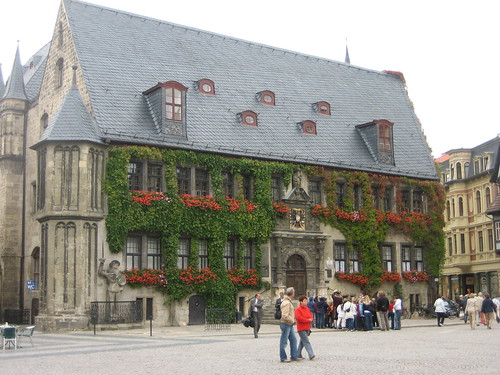
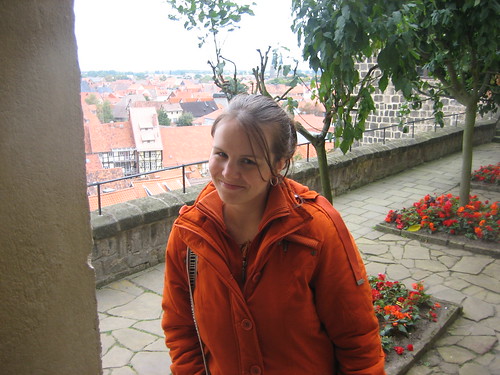
And here are a few shots of the Rathaus (Town Hall), the church and castle on the aforementioned sandstone cliff, and a cute picture of my dear travel buddy on the castle terrace overlooking the town:


Next up in my Germany photo series is the East Side Gallery, but I'll be blogging about my weekend in Sligo first.

Wednesday, August 20, 2008

The Book of Spies

"I only regret that I have but one life to lose for my country."

Those are the last words of Nathan Hale, possibly the first American spy, seconds before he was hanged by the British in 1776. Hale, a young Yale-educated schoolmaster, was hired by Washington and betrayed by a loyalist relative. The British military official who condemned him to death allowed him to write farewell letters to his mother, sisters, and fiancé, and then tore them up once the noose was put around Hale's neck.

Right now I'm reading a wonderful "profusely illustrated" history of espionage, Brian Innes' The Book of Spies, published in 1966. I was reading this book in bed the other night, and (as I tend to do) I fell asleep with the light on. My sister came into my room to turn the light off, and while she was in the room I bolted upright in bed and started...well, 'screaming' isn't the word, they were more like little yelping shrieks. (That wimpy noise was in itself embarrassing--I like to think if there really was an intruder I'd be able to scream properly.) Anyway, I'm pretty sure I was having a dream, a scary dream with spies in it, and for those few seconds before I woke up Kate became part of it.


Scared the bejeezus out of my poor mother!