Showing posts with label writing. Show all posts

Wednesday, September 1, 2010

Said and Unsaid

I was thinking about dialogue on the Greyhound bus ride home the other day. I have borrowed many a good line from strangers on public transport—the gem of that trip was 'Have you been to the bathroom in Baltimore? I felt safer in prison'—and sometimes these lines are so good they sound like they HAVE to have been made up.

Here's an example. I wrote the following, and my editor asked me to change it because she couldn't imagine anyone actually speaking this way:
Every so often I get a craving for the kind I can’t find at night. You know the sort of man I mean: a vegetarian Buddhist in thrift-store corduroys, doesn’t drink, rarely pays a visit to the barber. Last time I found one I was coming home on the PATH train at half past six on a Sunday morning; he boarded with a friend, both with twelve-speed bicycles in tow. I knew I had to have him when I heard him say, “You know when you’re riding down a country road and come upon the skeleton of a barn? I love that.” He didn’t notice me then, but I made sure he left his pocket journal on the train...
Yes, I heard a guy say that, word for word. I loved how much that offhand remark told me about his personality, and the well cared for bicycle at his side reinforced my impression. I didn't go home with that boy, but Eve sure did.

What can really make good dialogue, though, is all the things that go unsaid. Here's another exchange I scribbled down on Monday afternoon:
HE: So...are you going to be around long enough for us to go out?
Something about being on a Greyhound bus gets me really horny. You'll do.

SHE: I don't think so. I'm too old for that shit.
I'll talk to you across the aisle, but there's no way in hell I'm going back behind the dumpster with you at the next pit stop.

HE: Yeah, I don't do the bus thing either.
[a moment later] But I can cook up seafood better than you can buy it at the harbor.
I'm gonna pretend like you didn't just shut me down. In fact, I'm gonna give you one more chance, because I haven't met a woman yet who could resist my crabcakes...
This reminds me of nights in the study room back in grad school, when Seanan would write two lines for every one line of dialogue he composed: one for what was coming out of the character's mouth, and the second for what he was actually saying. Dialogue—reading it, writing it, overhearing and 'appropriating' it—is one of the most delightful aspects of being a storyteller, and doing it well makes it just as satisfying for the reader.

Monday, May 17, 2010

'Home is the sailor, home from the sea.'

My grandpa Ted passed away this afternoon. He was ninety, and hadn't been well in quite awhile, but it still came as a bit of a shock. You know how, when you're little, you think your parents are invincible? That's how I'd always felt about Grandpa Ted.

(With his father and four of his six sisters. Thanks to our cousin Paula for this picture.)

During the war my grandfather was a petty officer aboard a destroyer in the South Pacific. He went for more than a year without setting foot on land, and that was the easy part—he'd survived kamikazes and two typhoons, during which the temperature in the engine room reached 180º F. When he got back to the States, he spent nearly a year convalescing in naval hospitals; for the rest of his life he dealt with some serious medical problems as a result of war-related injuries, and yet he always seemed to defy everybody's expectations. (Just to give you an idea, today he received Last Rites for the fifth time.) He never thought he'd live to see ninety; I sometimes joked he'd outlive us all.

(Summer 2005. This is how I want to remember him—robust, striding around the block in his Abercrombie & Fitch ballcap and t-shirt.)

(At the Mary Modern launch party with Grandpa Ted, Grandmom Kass, and Grandpop Mike, July 2007.)

We didn't always agree—heck, that feels like an understatement, given our diametrical political beliefs—but he was a good man, and I loved him very much.

(Two pics from summer '06, with kids and grandkids.)

I want to tell you the story of how my grandparents met. At the naval hospital in San Diego, they told him they were sending him home to New York for his big operation, and gave him a choice between hospitals in Queens (St. Albans) and Brooklyn. He knew that St. Albans was the newer hospital, and naturally he wanted to be treated at the best facility available. He opened his mouth fully intending to say “St. Albans,” but “Brooklyn” is what came out. If he’d chosen the hospital in Queens he would never have met my grandmother.

She was a lovely 23-year-old volunteer social worker, midway through an M.S.W. she would never complete. Sitting up in bed, he’d strain for a glimpse of her as she passed by his room. So he could speak to her, he kept asking for another pack of playing cards, and she asked him tartly how he could possibly lose so many decks. He wore her down, of course, and they married seven months later.

I've always been fascinated with this story for that one inexplicable slip of the tongue. Thank you, thank you, thank you for choosing Brooklyn, Nonno.

(What's even more uncanny is that she wasn't supposed to be in Brooklyn either—she'd been assigned to a hospital in Trenton, but another volunteer, who'd been assigned to Brooklyn, asked my grandmother to switch so she could be close to her family. My grandmother agreed, even though Trenton offered free housing and Brooklyn did not. She was that nice.)

I'm so glad I got the chance to sit down with Grandpa Ted while he was still in good health and ask him about his childhood in Italy and his life during the war. I've been meaning to edit the raw audio and put all the stories on CD. Now would be a good time, eh?

(Outside the Brooklyn Naval Hospital, sometime in 1947.)

Home is the sailor, home from the sea. (I think I like the A.E. Housman version better than Stevenson's.)

[Note on 19th May: I have made a few edits to the above for historical accuracy—after talking to my aunt Eileen and listening to the stories we recorded in 2007, I realized I'd made a few mistakes.]

Sunday, May 2, 2010

Recap

I've been back from Yaddo several days now, and it's all starting to feel like a marvelous dream. To be able to write and read all day in a quaint little sun-lit study with no interruptions whatsoever, and a plastic lunch pail packed with a sandwich and fruit and carrot sticks wrapped in wax paper; to go for a run in the woods, or lay my yoga mat out on the back porch, and listen to the birds and the squirrels going about their business in the trees; to meet up with new friends at dinner, and play games in the pool house and have wine and snacks by a fire in a cozy sitting room, and to go back to work for a little while afterwards, if I felt like it...the whole experience was magical, it really was. One Saturday I laid in bed all afternoon reading Neverwhere—even ate my lunch in bed—and I didn't feel one bit guilty about it!

As I said, I was a little nervous about going without internet access, but it actually felt really good to be unplugged and unreachable, unless I wanted to be (and I did quickly check my email a couple times a day, usually after breakfast and before dinner). And of course I was meeting so many interesting new people that I wanted to get to know them all better, rather than spend much time on the computer in the evenings. Everyone—staff and residents—was so incredibly kind and friendly!

I know each person's experience of an artists' residency is going to be a bit different, and I think we were all looking to gain slightly different things, but for me the social aspect was almost as important as the actual work. We talked for hours about books (our own, and others'), and art, and pop culture, and shared horror stories from our childhoods, and I went to bed every night just feeling really, really content. I was fortunate enough to give my first-ever reading of Petty Magic after my new friend Nova read from her forthcoming novel, Imaginary Girls (look for it, summer 2011...it's going to be amazing!)—and even more fortunate afterward to be able to have one of those marvelous conversations with her that would, the next morning, allow all the disjointed bits of my fledgling novel to click into place. I love that kind of conversation—one you can look back on as a real turning point.

So, if you are reading this and thinking of applying to Yaddo, I have one piece of advice: DO! If you haven't published a book/had a show/whatever yet, don't let that stop you; part of what makes Yaddo so awesome is that they bring together writers and artists of all levels of experience.

Saturday, April 24, 2010

Yaddo in Pictures, part 2

The stairs at West House; two views of my study; reading on the back porch on a sunny afternoon; a walk in the woods.

Wednesday, April 21, 2010

Yaddo in Pictures, part 1

A neo-gothic pile; the gardens (which are open to the public); Katrina's room; another view of the mansion; one of the gargoyles in the dining room (gosh, that sounds familiar...)

Wednesday, March 31, 2010

Going Dark

I'm leaving for Yaddo today, and I've promised myself there will be no blog-reading, tweeting, or facebooking while I'm there. Wild with anticipation, of course, but there's also a whiff of ‘trial by fire’ about the whole thing: either I have the most productive month of my life, or I go completely potty from internet withdrawal. (There is internet access, just not in the studios, and I know I won't be sneaking into the WiFi area during working hours for fear of being seen. Sometimes shame is a very good thing.)

(What I'm packing: a copy of Mary Modern for the Yaddo library, some Petty Magic ARCs, one of the Moleskine notebooks Elliot gave me for Christmas, lots of looseleaf paper and gel pens, and a bunch of great books for research and/or pleasure. There's also a book of Dürer etchings—I thought I might use them for inspiration, you know, just sit and ruminate on "The Four Horsemen of the Apocalypse" until I start getting ideas. I'll let you know how that little experiment goes.)

If I can get some good photos (and permission, when needed) I’ll be sure to post them (after 4pm!), and in the meantime this thing is set to auto-blog: more photos from Eastern Europe, great books, and some random nerdy stuff.

Tuesday, March 16, 2010

Process, part 2

(Process, part 1.)

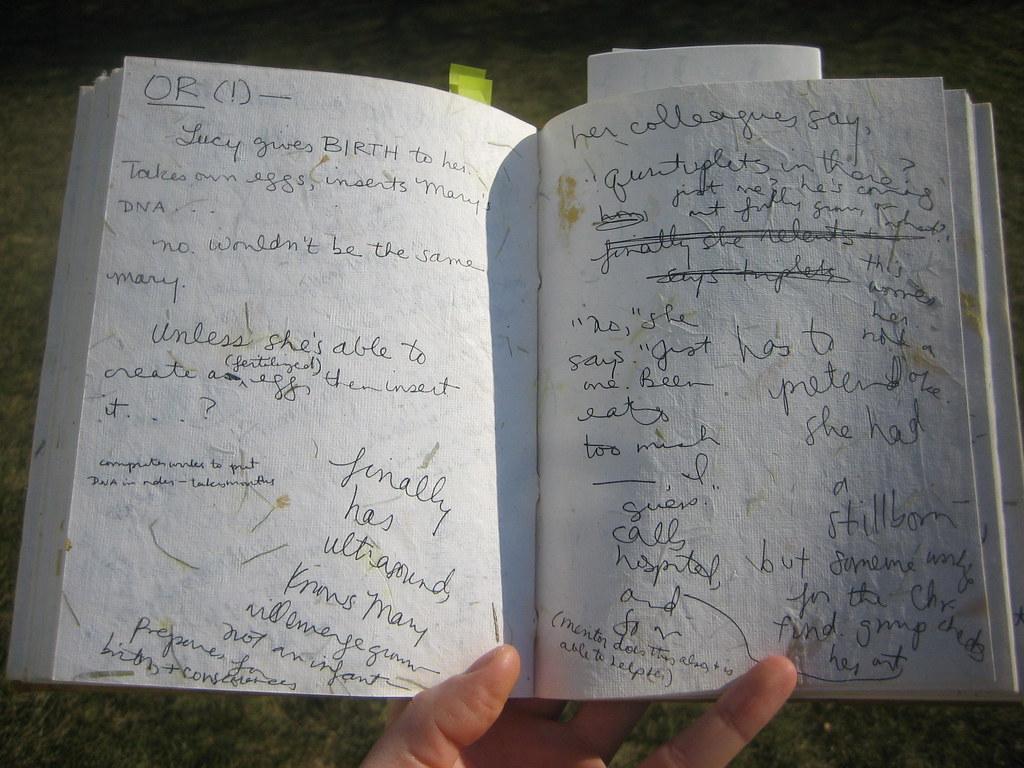
Here's a page from one of my NUIG notebooks. People always seem surprised that I don't write in chronological order, but to me it makes sense (during the rough draft, once the thing has been loosely plotted) to write whichever scene I feel like writing, and stitch them together afterward.

mm chicken scratchings

(Click here for a better view.)

In this case, I'd only just started the draft in earnest (notice the date up top: 6 October 2004), but I was already working on the graveyard scene that begins on page 218. Some famous writer said that if you know how your novel is going to end before you've written it, then it isn't worth writing at all. Biggest load of baloney I ever heard.

Tuesday, March 9, 2010

Process

I was sorting through old journals recently, and found some very rough notes for Mary Modern taken before I even got to Galway.

(Better view here. Or just click on the photo.)

I thought it might be fun to put up a few pages to give you a glimpse of the story in its earliest stage of development. (I don't know about you, but I eat this stuff up.)

(Better view here.)

After all, you've got to start someplace...

Thursday, February 4, 2010

We pray for those we have loved, and see no more.

While I was in Rye I entered St. Mary's Church during the daily service, and decided to sit down in the back and pay attention just for curiosity's sake (I'd never been to an Anglican service before). This line from the prayers of the faithful has stuck with me—we pray for those we have loved, and see no more.

Today would have been my grandmother's 87th birthday. She's been gone nearly fourteen years but I still miss her every day, and every time I pass the cemetery I think about the day they bought the plot, how she told my parents they could wave whenever they drove by on Route 130. Then, according to my dad, she started laughing hysterically, which kind of weirded him out; but if I'd been there, I know I would have laughed too.

Anyway, every so often doesn't it feel good to celebrate the people who have helped make us who we are? My grandmother was kind and smart and patient and wise. She was selfless to a fault. She made the best meatloaf (and I say that as someone who hasn't eaten meat in almost ten years). She was one of the few adults who would play games with us—Old Maid, Go Fish, Trouble, and swimming races. She always let me win.

And she was, of course, a voracious reader.

Now this portrait looks over my writing desk.

Wednesday, November 11, 2009

Too Many Hobbies?

After spending my childhood drawing and painting, I feel that part of me has atrophied—I may be a published author, but in another sense I still feel creatively unfulfilled. I wanted to be a fashion designer when I was a kid, which probably has a lot to do with why I'm so obsessed with knitting now.

Last spring (thanks to Margaret) I discovered Writing Alone and With Others by Pat Schneider, which is one of those great books on craft and practice that can change your life, if you let it. But one of the passages that struck me most concerns everything that isn't writing or reading: the concept of too many hobbies. Schneider proclaims, "I gave up sewing forever," and rather implies that there is no room in a writer's life for any other creative endeavor. I don't know that she meant to say this, but that's the impact it had on me, and naturally I have to disagree.

To a certain extent I think the practice of diverse arts can enrich and inform, like creative cross-pollination; but there's no denying there is such a thing as too many hobbies, leaving one feeling scattered and unaccomplished in the few activities that matter most. There never seems to be enough time to do everything because there isn't enough time to do everything. A couple of recent posts on the Unclutterer blog have driven this home for me (Saying farewell to a hobby, part 1; part 2).

The trouble in giving these hobbies up, though, is that on some level we all think we can be Renaissance women and men—if we only devote enough time to each thing in which we think we ought to excel, then we will, and in the process we will become better, more "well-rounded" people. I "ought" to speak at least two foreign languages, play the guitar, sew my own sundresses, knit all my own sweaters, paint and read and write. But we can't all be Leonardo da Vinci, and if you've ever read his biography you'll know that's actually a good thing.

I have a left-handed Fender acoustic guitar in my closet that hasn't come out of its case in years. I guess I should find it a better home. I know I'll never be as good a painter as I am a writer, even if I do take it up again. But I'm not really talking about jettisoning the hobbies you aren't AMAZING at—if you love to do it, it doesn't matter if you aren't "good enough" to do it along with the pros.

Maybe it comes down to this: if you're truly passionate about it, you're already doing it. What do you think?

Wednesday, October 7, 2009

Love only what you do, and make.

When I applied to Yaddo a few months ago, I wasn't thinking too much about my chances. It was something proactive at a time when I needed to be thinking about the future, so I felt good just dropping the application in the mail. As the day of judgment approached, though, I half-convinced myself I couldn't get in, despite the warm encouragement of Jonathan Santlofer (former Yaddo board member, artist, author, and all-around awesome guy).

But I did get in! I got the letter on Friday. This is a tremendous honor and opportunity, and I intend to suck the marrow out of the whole experience. So many 20th-century American heavyweights have stayed at Yaddo—Truman Capote, Langston Hughes, Eudora Welty, Flannery O'Connor, John Cheever, Sylvia Plath, Ted Hughes, and on and on—it's very humbling, to think of them.

Of that list of luminaries, Sylvia Plath's is the name that resonates most with me, though I feel a little guilty admitting it. Not that she wasn't a brilliant poet, but her work is the stuff you live on when you're nineteen and hopelessly misunderstood (or such is your belief at the time). I picked up a copy of The Unabridged Journals when I was in college, and naturally I had to go back and read the entries she wrote at Yaddo in the fall of 1959. She sketches ornate old furniture and wall sconces, describing photographs and engravings in minute detail, and frequently doubts the quality and importance of her work:
I feel a helplessness when I think of my writing being nothing, coming to nothing: for I have no other job - - - not teaching, not publishing. And a guilt grows in me to have all my time my own. I want to store money like a squirrel stores nuts. Yet what would money do. We have elegant dinners here: sweetbreads, sausages, bacon and mushrooms; ham and mealy orange sweet potatoes; chicken and garden beans. I walked in the vegetable garden, beans hanging on the bushes, squash, yellow and orange, fattening in the dapple of leaves, corn, grapes purpling on the vine, parsley, rhubarb. And wondered where the solid, confident purposeful days of my youth vanished. How shall I come into the right, rich full-fruited world of middle-age. Unless I work. And get rid of the accusing, never-satisfied gods who surround me like a crown of thorns. Forget myself, myself. Become a vehicle of the world, a tongue, a voice. Abandon my ego.

Try a first-person story and forget John Updike and Nadine Gordimer. Forget the results, the markets. Love only what you do, and make. Learn German. Don't let indolence, the forerunner of death, take over. Enough has happened, enough people entered your life, to make stories, many stories, even a book. So let them onto the page and let them work out their destinies.
A 27-year-old acclaimed poet, bemoaning her wasted youth! (Also, of course, ridiculously ironic given the manner in which she died.) But I love what she's getting at in the second paragraph: it isn't about you, it's about the story. You have nothing to prove, and everything to tell.

Friday, September 25, 2009

The day I became a writer

It was May 1, 1996. My 9th-grade English teacher, Mrs. Gaffney, was out sick, and the substitute brought us to the library and told us our assignment was to pick one of the prints on the walls above the bookcases and write a story about it. It was busy work, but an easy 20 out of 20. I chose a picture of an old farmhouse at dusk, and decided to write a story about a girl listening to her grandmother telling stories on a porch in the twilight—the time of day being, of course, a metaphor as light as an anvil.

At the time my grandmother was very, very sick, but I wasn't thinking much about her as I wrote. This was fiction. Where my narrator's grandma told fanciful stories that made her granddaughter doubt if she was 'all there,' mine was still living very much in the present—and was as reluctant as ever to tell any stories about her life. Why did I write that stupid story instead of actually calling my grandmother to tell her I loved her? It was the last night I'd ever have the chance to do it.

But I didn't. I printed the two-page story, tucked it in my notebook, and turned it in to Mrs. Gaffney the following day. And that afternoon, on May 2nd, my grandmother passed away.

A few days later—I can't remember if it was before or after the funeral, which was on May 5th—my teacher passed back our graded writing assignments. I had forgotten all about it, of course, but I felt sick when I remembered what I'd written. The horrible irony of it!

But as if that wasn't bad enough, there was a secondary indignity that pretty much lit the fire under me: Mrs. Gaffney had given me an 18 out of 20. An A-. Mind you, this was the type of assignment we always got 20 out of 20 on. And mind you, I wouldn't have cared if this had been any other day, or any other assignment. I went up to her after class and asked her why she'd given me a lower grade, and she said something to the effect of creative writing being subjectively graded (looking at the print-out right now, it occurs to me that it might have had something to do with the obnoxious font I used). Anyway, I don't think I told Mrs. G. the real reason why I was so upset (there were a ton of overachievers at Mo-town, so complaining about A-minuses happened all the time), but when I got home that night I opened a new word processing document and typed, "I'm going to show Mrs. Gaffney! I'm going to be a writer."

And I did show Mrs. Gaffney, who hightailed it home from her golf tournament one day in July 2007 to hear me read from Mary Modern at the local Barnes & Noble. I've never told her what a big part she played in making me a storyteller, but there it is.

Friday, July 3, 2009

Make Do and Mend

How exciting is this: I've got an essay in this week's episode of Cast On, which is far and away my favorite podcast! The series theme is 'Make Do and Mend,' taking inspiration from WWII-era booklets on repurposing and economizing. I'm continually inspired by my grandparents' thrifty lifestyle (I've already told you about the candy tin o' buttons), so that's what my essay is about. I know a lot of you reading this aren't knitters, but Brenda's podcast is well worth a listen regardless.

I have so many items of clothing ready to be mended or repurposed—the challenge is actually getting down to making the alterations. There's the vintage 100% wool cardi I mention in the essay, which I think will become a button-down vest from A Stitch in Time (a huge, beautifully illustrated book of modernized vintage patterns, which is on my Christmas wish list). There's another purple sweater I got for Kate when I worked at Anthropologie back in college, which is half-felted; I might as well felt it all the way and make a throw pillow out of it. I have a mohair jumper my mom got me at Kilkenny Design when I graduated with my M.A.; it's forest green, a good color for me, but the design itself is none too flattering (why did it take me so long to realize that?!), and someday I want to frog it (mohair...yikes!) and reuse the yarn so it can still remind me of graduation and my mother's generosity. And I have a sweater I got in Dublin in 2001 that has a hole in the elbow; I still love it, it's purple and in perfect condition otherwise, so I need to pick up some matching sock yarn to knit a pair of elbow patches. I have a feeling I'm going to have to visit more than a few yarn shops before I find a color that's close enough.

And I have yet another project that's all about the buttons: my mother has a black cotton cardigan with beautiful sparkly ones that she never wears because the garment itself is faded. As it is, those buttons are going to waste. So for Christmas I’m knitting a classic cardigan that will showcase those lovely buttons (it was her idea), and that faded but still serviceable cotton cardi will get a plainer set of buttons (out of the tin) before it’s donated to Goodwill. Two sweaters out of one!

But add all these makeover sweaters to a huge pile of unfinished sewing and knitting projects, and it's really overwhelming. Right now I really only have one completed 'make do and mend' project to boast of, and it's five or six years old. My favorite jeans had huge holes in the seat, too big to patch, so I decided to make a yoga mat bag out of one of the legs. I cut out a circle for the bottom out of the other leg, used a sparkly purple shoelace for a drawstring, and a rainbow-striped belt for the strap. Now that I've got my mom going to yoga classes, I figure I can use some corduroy scraps to make her a mat bag too. I'll just have to add it to The List.

Next entry: vintage sweater #3!

Wednesday, July 1, 2009

Moldy Oldie: Trash Your Panties!

Awhile back I mentioned this Washington Square News "op/ed" I wrote in the spring of 2000. It was headlined "Trash Your Panties: Going Commando With Camille." Sadly, it was by far the best thing I ever wrote for the paper. Hope you enjoy it.
Thirty years ago we burned our bras. We didn’t go far enough.

I have issues with underpants. They are expensive, unnecessary and often uncomfortable. No one ever seriously considers the possibility that we women could avoid the nearest Victoria’s Secret (or K-Mart) altogether in favor of a far more authentic way to live - with perfect freedom.

The prospect of going “commando” always makes for a hearty laugh, and it’s true that there’s no better place for a pair of lacy panties than atop an inebriated frat guy’s head. But why do we bother wearing underpants at all? Underwear, if you’re in the market for something a little more feminine than a pair of bland white cotton undies, will cost you more money than I consider it to be worth.

A girl makes a trip to the lingerie department for one reason and one reason only, whether she admits it or not — she’s looking for the most enticing scrap of something sheer and frilly just in case the opportunity for a certain type of encounter with the opposite sex should arise. In that case, why bother wasting $30 on a pair of underpants that are just going to be ripped off with wild beastly abandon anyway? So what if the joy of unwrapping the present is gone with the panties; we have more important assets to make use of.

Not that I’m advocating a panty boycott to make it easier for those crazy boys. It makes absolute sense that female underwear evolved from the chastity belt, the ultimate symbol of feminine oppression. It is for that very reason that we should abstain from wearing panties; such a defiant act would symbolize quite appropriately the social freedom we continue to desire with such fervor.

Fetishization of female undergarments is certainly widespread; girls, if you’re ever in desperate need of tuition money, you can always sell your panties steeped in that oh-so-attractive “natural aroma” online and make a bundle. (If I weren’t so concerned with simple decency, I might advocate ridding yourself of every pair you own by this method; it’s certainly more profitable than throwing them out in the trash.) If we were to avoid the wearing of underpants, men would have to find a more productive and meaningful garment to worship. I suggest socks because of their wintry practicality and distance from the danger zone.

Reasons of simplicity and freedom aside, we should reject the restrictions imposed upon us by underwear simply because this article of clothing is a constant source of male delight and strange fascination. We still want them to be fascinated, of course — just not with our panties. Getting rid of them now would force men to hurry a little faster along that evolutionary path. The absence of underwear also makes it easier for the more carnal and filthy-minded among them to get what they want, but I’m not worried. Men like that use newspapers for house-training themselves rather than for reading material, so if this idea catches on, they won’t know about it.

No more annoying wedgies, no more unsightly panty lines and no more hard-earned money wasted on garments that nobody is ever going to see. (At least that’s what your mother thinks.) It’s a curious thing that no one ever included the suggestion to “get rid of your underwear” in any of those “Simplify Your Life” books. Spend your money on something more practical, like ice cream, crossword puzzle magazines or itching powder. I’m holding onto my bra though; there’s a three-letter word that begins with S and ends with G that scares me too thoroughly to light that match.

Thursday, June 25, 2009

Note to Self

"Before publication, and if provided by persons whose judgment you trust, yes, of course criticism helps. But after something is published, all I want to read or hear is praise. Anything less is a bore, and I'll give you fifty dollars if you produced a writer who can honestly say he was ever helped by the prissy carpings and condescensions of reviewers. I don't mean to say that none of the professional critics are worth paying attention to—but few of the good ones review on a regular basis. Most of all, I believe in hardening yourself against opinion. I've had, and continue to receive, my full share of abuse, some of it extremely personal, but it doesn't faze me any more. I can read the most outrageous libel about myself and never skip a pulse-beat. And in this connection there is one piece of advice I strongly urge: Never demean yourself by talking back to a critic, never. Write those letters to the editor in your head, but don't put them on paper."

—Truman Capote, from an interview in the Paris Review, 1957.

Thursday, April 9, 2009

In Despair, or in Cahoots?

They've been called "the drinking man's Coldplay," but Elbow are in a league beyond that much more famous British pop/rock band. (As Brian Boyd wrote when Elbow won the Mercury Prize last year for The Seldom Seen Kid: "A band such as Coldplay will happily confess to you that they put filler on their albums in the knowledge that there are enough big, anthemic songs around the filler that no one will really notice or care. Chris Martin has fessed up to 'borrowing' from Elbow's Grace Under Pressure song to help him with the writing of Fix You." Listen to those two songs one after the other, and Coldplay's debt becomes remarkably obvious.)

So please, let me indoctrinate you into the greatness that is Elbow. Here's a link to a BBC video Brendan's sister Aileen posted to Facebook yesterday:


Oh, kiss me like the final meal / Yeah, kiss me like we die tonight

Doesn't it make you feel happy to be alive?

Music can really inspire me when I write. It sets the mood in a scene, of course—I used plenty of Nina Simone lyrics in Mary Modern, and my Petty Magic heroine sings a wistful Berlin cabaret tune, Irgendwo auf der Welt ("Somewhere in the World"), during a pub session. The best lyrics inspire as well, perfectly evoking a scene with only a handful of words. Take these lyrics from Fugitive Motel:
Curtains stay closed
But everyone knows
You hear through the walls in this place
Cigarette holes for every lost soul
To give up the ghost in this place
It's all there—the despair, the isolation, the claustrophobic shabbiness of a highway lodge advertising cable TV and ceiling mirrors in every room.

Or take this single line from Switching Off:
Early evening June, this room and a radio play
Can't you just see the fluttering curtains, the trees outside casting dancing shadows on the unmade bed? Can't you just feel the cool breeze wafting through the window and the tinny voices coming from the radio on the dresser? The character in the song re-lives these memories so vividly that it puts the listener there in that moment as well. Switching Off has another of my favorite lines:
You, the only sense the world has ever made
You can see why this music makes me want to be a better writer.

Wednesday, March 25, 2009

Fine weather, part two

We spent last weekend in Carrick. It was Mother's Day on Sunday, and Brendan's nephew's birthday, and I also spoke to a creative writing workshop on Saturday morning. This particular workshop uses the Amherst Writers and Artists methodology, which makes for a more supportive environment. (I skimmed parts of Pat Schneider's excellent book, Writing Alone and With Others, and will soon be picking up a copy of my own. More on this in a future post.)

Here's the title page of a slightly older book in the O'Brien family library:

Cool, huh?

On Saturday evening we went to Kilkieran Cottage, an adorable restaurant with this lovely view (I took this picture from the car park):

Within that graveyard are the Kilkieran high crosses, which I must visit in daylight the next time I get down there. Kilkieran is just over the border in Kilkenny, a 15-minute drive from Carrick on Suir. I'll be writing up Kilkieran Cottage in the second edition—the food (I had the mushroom and asparagus risotto and the rhubarb crumble) was delish and the service was very good. (You can see the cottage in the background of the top photograph on the Megalithic Ireland page I linked to above.) I have a soft spot for gourmet restaurants in the so-called middle of nowhere...makes a good meal feel that much more special, don't you think?

On Sunday we took a walk through Seskin Wood, on a hill overlooking town, river, and pasture.


Gorse bushes may be common enough, but the sight of all those cheery yellow buds always makes me happy.

Wednesday, July 2, 2008

The Paper Mammoth

Have you noticed the "Writers' Rooms" link on the right side of the page? I've been daydreaming about a proper study-slash-studio since I was a teenager, and that weekly feature in the Guardian fuels my reveries. I love looking at other writers' workspaces and reading about why they've chosen a particular location, piece of furniture, or wall decoration, and how each element helps (or hinders) them in their work. In my head I've painted the walls and installed (and filled) the bookcases and chosen the upholstery for the wing-backed chair in the corner, scoured junk shops looking for the perfect big old desk, and finally settled upon the perfect filing system. I'm so nerdy I even want to organize my shelves with the Dewey decimal system (um...no...not even kidding).

Of course--seeing as I live in a rented room, do most of my writing at the library, and have books and notes scattered between three separate domiciles--the only part of this fantasy that is currently relevant is the bit about the filing system. I do a lot of talking about "getting organized." You could say that my chaos must be functional enough if I've managed to produce a few publishable manuscripts out of it, but that's not good enough.

It isn't so much a matter of every book, print-out, and notecard being in its proper place as much as having an effective system for filing ideas. I have lots of notes on receipts and torn bits of notepaper, and I do manage to hold on to most of it, but it's all very inefficient. You can just write every random thought down in a notebook, but then each of those individual ideas are eventually going to need sorting according to their respective projects (in a single notebook I could have notes for the project at hand alongside ideas for future novels and stories, notes on a local restaurant I want to write up for the second edition, lists of books to read, and even sketches of sweater designs I'd like to use as inspiration once I have the skillz to knit it). So how to sort it all while keeping it portable?

At first I thought index cards were the best way to go...but then how would I sort and store them? I've tried recipe boxes with tabs, but that seems to work better for sorting ideas within a single project. And if the idea could be expressed in only a word or two, it seemed a little silly to devote a full-sized index card to it. I also started using Stickies as virtual index cards, but then my hard drive crashed and I lost it all. (Incidentally, the Mary Modern folder was the only thing the tech guy was able to retrieve. KISMET!)

Then I had the idea to sort all ideas:


I had asked my dad for a Rolodex a couple Christmases ago, but then I realized I'm too nomadic and didn't know enough people to bother actually using it (and yes, the address book on my iBook dock makes a Rolly pretty much obsolete, but see previous paragraph for why I don't use it much.) I've got tabs for words and phrases, witticisms ("If you had a penis you'd understand" --guess who), witchy business, WWII flashbacks, and so forth, and another tab for everything that isn't Petty Magic. That stuff can be sorted later. So far it's working out pretty well. The only annoying thing is that Rolly cards are actually rather expensive, and I need to find a hard case for when I travel with it.

I know: I'm a total nerd. A pedant, even. Call me what you like, so long as I can keep it all straight.

Wednesday, June 25, 2008

Mary Modern now out in paperback!

I almost wet myself with excitement the day my editor emailed me the new paperback cover. Isn't it incredible? The über-talented Dan Rembert designed both covers, but he really outdid himself with the re-design. You can't see it too well in the jpeg, but those faint horizontal lines are DNA code. Captures the quirky spirit of the book just perfectly.

At the back of the book you'll find a reading group guide as well as an author essay written especially for the paperback edition. I wrote about how this photo of my great-grandparents sparked the idea.

Hard to believe it's been a year since the novel came out. I'm trying not to think about how well the paperback will end up selling, and actually, it isn't all that hard when my head is so full of plot lines and bits of dialogue from Petty Magic...

Sunday, June 15, 2008

Thoughts on Criticism and Rejection

Rejection is hard. It gets a little easier as you go on, but not by much. The sooner you start to devise little coping strategies to keep your ego patched, the better off you'll be.

Whenever I got to feeling down over a rejection (or, later on, a snarky Amazon review), I thought: Well, the person who is criticizing me [an editor, reviewer, or random reader] can’t do what I’m doing--they don’t have the guts, or the talent, or either of the two. This may sound snarky in its own right, and maybe it is. It also isn’t fair to all those wonderfully talented editors and agents out there, those midwives and shepherds of the literary world. Then again, I’ve found that the most talented editors and agents in the business do not write rejection letters that leave you feeling like a sack of elephant crap. Those are the letters--tactful, and sometimes even very encouraging--that spur you on.

This attitude I’m talking about--THEY can’t do it and therefore I should take their criticism with a grain of salt--is merely a coping strategy. I'm not talking about the criticism that you know in your heart is wise and right on the money. This is just something to keep in mind when you start feeling like you’ve seriously overestimated your own talent. Even if you’ve written the sloppiest, most derivative novel ever put to paper, a manuscript that will never see publication, you’ve still accomplished more than most folks ever do.

I'm not discounting the job of reviewers. Literary criticism is as necessary as literature itself, and can be every bit as enjoyable to read. It just drives me nuts when I read a snarky review. It's like when a reviewer takes pains to include some line about Mary Modern not holding a candle to the original Frankenstein. First of all, it's NOT Frankenstein, nor is it a retelling. Nobody was claiming on the dust jacket or marketing materials that I wrote an instant classic. It comes off sounding like a jab, and it's completely unnecessary. In another case, a reviewer dismissed my characters as ciphers--never mind that I can tell you every character in that book is based on a person (or, more often, a series of people) I've known in real life. As I read that particular review, it was abundantly clear that the reviewer had decided not to like my book before he even cracked the spine.

You definitely start to sense a bit of envy between the lines of these reviews sometimes. Perhaps the reviewer is himself a frustrated fiction writer, so he says your work is derivative, mediocre, or what have you. Mind you, I'm not whining or being underhandedly smug here--I'm saying this because I often felt this impulse myself before I was published. I have taken notice of several literary catfights in recent years, most memorably between Laura Miller of Salon.com and the novelist Chuck Palahniuk. She wrote a review of Diary in 2003 that was so unbelievably negative it was downright undignified, and he responded with a letter to the editor that had me jumping with glee:
I have never responded to a review, perhaps because I've never gotten such a cruel and mean-spirited one.

Please send me a copy of your latest book. I'd love to read it.

Until you can create something that captivates people, I'd invite you to just shut up. It's easy to attack and destroy an act of creation. It's a lot more difficult to perform one. I'd also invite you to read the reviews Fitzgerald got for "Gatsby" from dull, sad, bitter people -- like yourself.

Amen, Chuck.

(By the way, I haven't read any of Mr. Palahniuk's novels, but I don't care if Diary was the worst piece of tripe published in this or any other century; nothing could justify the writing of probably the nastiest, snarkiest piece of "journalism" I have ever read. Even this Salon critic's less controversial columns have really annoyed me from time to time--like when she dismissed David Mitchell's Cloud Atlas--which is an utterly sublime novel--as an albeit-fun pastiche. She's sounding more and more like a frustrated novelist, eh?)

Anyway, the upshot of all this is that one must read a book review with a critical eye. Sometimes reviewers are needlessly harsh for reasons that have more to do with them than the author, and sometimes there are good reviews of mediocre books written by acolytes. Sometimes there are reviews of books by great writers that are criticized by novelists whose work is patently inferior, or a novelist who is insecure about her own place in the literary canon and acts on an urge to cut down a fellow author. And sometimes, once in a blue moon it seems, there's a thoughtful review written by someone with no angle at all.

But that's not the real reason I've stopped reading book reviews. The real reason is that avoiding them is another coping strategy for me--otherwise I'd be reading glowing reviews of books with rehashed plots thinking, Damn it, why did this newspaper ignore my book? Also, I stopped reading the Amazon/Librarything/whatever reviews not too long after Mary Modern was published. There are some really ridiculous ones out there--there's at least one two-star review that spells my name "Deangeiiis," and says my book was poorly edited without even bothering to make a logical case for the assertion. WHO takes these people seriously? Who? Not me, that's who--those crappy, illogical, useless reviews can only raise my blood pressure.