I forgot to include this little video Kelly took in my Fat Tire entry the other day. It was so much fun watching people of all ages dancing on tables.
Tuesday, November 18, 2008


Monday, November 17, 2008
Adventures in Berlin: the Holocaust Memorial
 Kelly and I visited the Memorial to the Murdered European Jews two times, on our own and then the following day with the Fat Tire bike tour. Both times we found ourselves really frustrated by the hordes of teenagers who showed zero respect for the monument or the millions of Holocaust victims it memorializes.
This is not an amusement park. This is not a novelty. It is not appropriate to laugh loudly, play hide-and-seek, or chase each other on your bicycles.

At least they had enough decency to look sheepish when Kelly admonished them.
I know I'm sounding like an old crank here, but it's because I remember what it was like to be fifteen that I felt so justified in deploring their behavior. If this monument had existed when I was fifteen and I visited it on a school trip, I would have walked through it on my own, in silence, feeling both sad and hopeful that the atrocities of which this monument is a reminder will never be repeated.
Friday, November 14, 2008
Adventures in Berlin: Fat Tire (and Happy Birthday to Me!)
 Right: the ruins of the Kaiser Wilhelm Memorial Church.
Seanan beat me to Berlin by a couple of months, so he was able to point me to a few things of particular interest. He recommended a biking tour of the city with Fat Tire, and let me tell you, it was definitely one of the highlights of our trip to Germany. The tour guides at Fat Tire are brilliant—they all have degrees in German history, but they certainly know how to have a good time (as you would expect, they tend to be ladies' men). Our tour was supposed to last four hours, but it took almost six—I was so impressed that on top of a tremendously informative and entertaining tour, our guide wasn't rushing us back to the starting point so he could get on with his day. If you're going to Berlin, London, Paris, or Barcelona anytime soon, definitely check out their website to see if any tours fit your schedule. Thirty bucks (€20, and we also tipped €5 each) for a six-hour bike tour is a great value, no?
We stopped for lunch at a really nice beer garden/restaurant, and Kelly finally sampled the bratwurst. The veggie options were surprisingly yummy too. Another credit to Fat Tire that they didn't take us to a place that felt like a tourist trap.
 There were a lot of cool people on the Third Reich tour, and we met up with them again in the evening for the Fat Tire pub crawl. I'm not a big drinker, so I was probably the soberest of the lot, but gosh was it fun. I'll post separately about some of the places we visited on the bike tour and pub crawl (there's a famous artists' squat in a bombed-out department store I want to tell you about, and the Holocaust Memorial warrants its own post as well).
 (On the Bebelplatz, site of the infamous Nazi book-burning. Yes, I'm taking notes. I'm a nerd and I'm not ashamed of it.)
I got plenty of photos of drunken debauchery that night (other people's, not ours, mind you), but I think I'll just show you this one:
 And a few more landmarks we passed on our bikes:
 The ruins of Anhalter Station, once Berlin's central train terminal.
 Obama made his July 24th speech at the foot of the Siegessäule, the Victory Column, which is at the center of an enormous roundabout. Hooray for digital zoom! (There's a much better close-up on the Wikipedia page.)
Wednesday, November 12, 2008


Tuesday, November 11, 2008
Knocknarea
There is an epic suggestiveness which you cannot miss if you climb the mountain. You cannot keep your hold upon the present while you are up there.
A 45-minute plod up Knocknarea (from the Irish Cnoc na Rí), at an elevation of 329m, brings you to an enormous cairn known as Queen Maeve's Tomb. Here it is, blanketed in mid-morning fog:
 We walked up here last weekend with a few of Brendan's friends. The cairn is 55m wide and 10m high, and likely dates to the beginning of the third millennium B.C. It's never been excavated, but archaeologists speculate that the whole thing weighs 40,000 tons, and that there might be a passage tomb underneath on par with Newgrange. Forty thousand tons and counting, because people follow the tradition of bringing a stone from the bottom of the hill to drop on the cairn. Actually, according to the lovely lady who runs the B&B we stayed at (Pearse Lodge, on Pearse Road, a ten-minute walk from town—definitely getting "top pick" in the second edition), the original tradition was to take a stone away from the cairn. Obviously that couldn't go on indefinitely, so the Tourist Board reversed the tradition! There are similar traditions associated with lots of other mountains around the country.
The view from the summit has to be awesome, but both times I've visited it's been too foggy to see anything. These shots were taken on the way down (in the first one everybody is taking turns shouting into the valley and waiting for the echoes):

 Sligo is beautiful, isn't it?
—William Bulfin
A 45-minute plod up Knocknarea (from the Irish Cnoc na Rí), at an elevation of 329m, brings you to an enormous cairn known as Queen Maeve's Tomb. Here it is, blanketed in mid-morning fog:
 We walked up here last weekend with a few of Brendan's friends. The cairn is 55m wide and 10m high, and likely dates to the beginning of the third millennium B.C. It's never been excavated, but archaeologists speculate that the whole thing weighs 40,000 tons, and that there might be a passage tomb underneath on par with Newgrange. Forty thousand tons and counting, because people follow the tradition of bringing a stone from the bottom of the hill to drop on the cairn. Actually, according to the lovely lady who runs the B&B we stayed at (Pearse Lodge, on Pearse Road, a ten-minute walk from town—definitely getting "top pick" in the second edition), the original tradition was to take a stone away from the cairn. Obviously that couldn't go on indefinitely, so the Tourist Board reversed the tradition! There are similar traditions associated with lots of other mountains around the country.
The view from the summit has to be awesome, but both times I've visited it's been too foggy to see anything. These shots were taken on the way down (in the first one everybody is taking turns shouting into the valley and waiting for the echoes):

 Sligo is beautiful, isn't it?
Thursday, November 6, 2008
Here Lyeth the Boby
HUZZAH!!!!!!!!!!!!!!!!!!!!!!!!!!!!!!!!!!!!!
(Now back to your regularly-scheduled blog entry.)
 Brendan and I spent the weekend in Sligo, where I did a bit of research for the second edition of Moon Ireland. Most visitors come to pay homage to William Butler Yeats, who is buried in the graveyard at Drumcliff not far outside town, at the church where his great-grandfather was rector. We, on the other hand, came to socialize, shop for wooly goodness from County Donegal, climb up Knocknarea (pictures next post), and listen to Renaissance choral music in the ruins of Sligo Abbey. It was awesome. Here are some of my best shots from the abbey.


And here's a shot from the concert, which was actually part of a larger project by English filmmaker Sonia Boyce (you can see her with her camera on the bottom left of the photo below. Notice, too, how the choral director is standing on a grave slab.) A "sound artist" made shrieking and humming sounds to form a sort of "dialogue" with the choral singers. (You can't see him in this shot, but he was wearing jagged cardboard wings, a sort of white neck-dress, and a white robe. This element of the performance was somewhat pretentious, but I enjoyed it regardless.) The choral group is UK-based Alamire, and you can see a clip from the video installation here.

The abbey itself was a real treat too. The last time I visited Sligo was during the week in wintertime, so I wasn't able to visit it. The cloister and Gothic and Renaissance tombs are all remarkable, and I got a macabre history lesson from one of the guides behind the front desk. The buildings have a sunken appearance, he said, because of all the people buried in the surrounding graveyard during the cholera epidemic of 1832. Fearing ongoing contagion, church leaders closed the abbey graveyard and opened a new one a mile outside town; but this land was so sacred to the Catholics of Sligo that they would go back to the new cemetery late at night to exhume their relatives and rebury them here. It had to be done hastily and without the aid of a lantern, so that body parts were often seen protruding from the earth. All these shallow graves led to a rising of the earth around the abbey walls.
I had heard that Bram Stoker's work was influenced by the horrors of that epidemic. More from Sligo: A Short History:
The guide told me that the dying were often left unconscious in open graves. The people who left them there were, of course, afraid of contracting the disease themselves. He said there was zero chance that these victims could recover...but what if they should wake up before they died? Too horrible to contemplate.
Here's another item of interest from the abbey floor:
 Why were James' family name and details effaced? It's possible he brought some sort of shame upon his family, or that his remains were reinterred elsewhere. Most interesting to me was the curious spelling of "body." According to the abbey brochure, the average stonecarver was illiterate.
(Now back to your regularly-scheduled blog entry.)
 Brendan and I spent the weekend in Sligo, where I did a bit of research for the second edition of Moon Ireland. Most visitors come to pay homage to William Butler Yeats, who is buried in the graveyard at Drumcliff not far outside town, at the church where his great-grandfather was rector. We, on the other hand, came to socialize, shop for wooly goodness from County Donegal, climb up Knocknarea (pictures next post), and listen to Renaissance choral music in the ruins of Sligo Abbey. It was awesome. Here are some of my best shots from the abbey.


And here's a shot from the concert, which was actually part of a larger project by English filmmaker Sonia Boyce (you can see her with her camera on the bottom left of the photo below. Notice, too, how the choral director is standing on a grave slab.) A "sound artist" made shrieking and humming sounds to form a sort of "dialogue" with the choral singers. (You can't see him in this shot, but he was wearing jagged cardboard wings, a sort of white neck-dress, and a white robe. This element of the performance was somewhat pretentious, but I enjoyed it regardless.) The choral group is UK-based Alamire, and you can see a clip from the video installation here.

The abbey itself was a real treat too. The last time I visited Sligo was during the week in wintertime, so I wasn't able to visit it. The cloister and Gothic and Renaissance tombs are all remarkable, and I got a macabre history lesson from one of the guides behind the front desk. The buildings have a sunken appearance, he said, because of all the people buried in the surrounding graveyard during the cholera epidemic of 1832. Fearing ongoing contagion, church leaders closed the abbey graveyard and opened a new one a mile outside town; but this land was so sacred to the Catholics of Sligo that they would go back to the new cemetery late at night to exhume their relatives and rebury them here. It had to be done hastily and without the aid of a lantern, so that body parts were often seen protruding from the earth. All these shallow graves led to a rising of the earth around the abbey walls.
I had heard that Bram Stoker's work was influenced by the horrors of that epidemic. More from Sligo: A Short History:
People were left dead in the streets and whole families were wiped out. Bram Stoker (the author of Dracula) had his macabre imagination fired by his mother, a Sligo woman, who told stories of coffin makers knocking on doors in the night looking for corpses and of victims being buried alive.
The guide told me that the dying were often left unconscious in open graves. The people who left them there were, of course, afraid of contracting the disease themselves. He said there was zero chance that these victims could recover...but what if they should wake up before they died? Too horrible to contemplate.Here's another item of interest from the abbey floor:
 Why were James' family name and details effaced? It's possible he brought some sort of shame upon his family, or that his remains were reinterred elsewhere. Most interesting to me was the curious spelling of "body." According to the abbey brochure, the average stonecarver was illiterate.
Monday, November 3, 2008
Adventures in Germany: Quedlinburg
 After three nights in Wernigerode, Kelly and I made an afternoon stop at Quedlinburg on our way back to Berlin. This town on the north-eastern edge of the Harz was one of the reasons I had wanted to come to Germany in the first place. I was struck by this passage in Resisting Hitler, a biography of the American scholar, communist, and German resistance member Mildred Harnack-Fish:
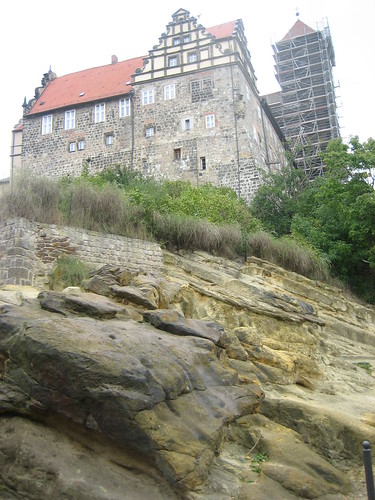
A romantic and evocative region abounding in medieval cathedrals and squares, the Harz has many literary associations, particularly with Heine and Goethe. On a postcard to Falk, Mildred wrote that "the beauty of the mountains, the rivers and forests under the great sun is powerful...Every evening we read Faust I together. It fits these surroundings." Mildred particularly liked Quedlinburg, with its schloss and Romanesque cathedral perched on a sandstone cliff. But it was the wild grandeur of the valley of the Brocken, with granite slopes that bore names like the "Witches Washbasin," "Devil's Pulpit," and finally the "Witches' Dancing place"—where each year on the Witches' Sabbath, Walpurgis Night, the spirits gathered—that formed the romantic backdrop for their nightly readings. "You can only appreciate the landscape of the Harz if you go by foot as Goethe has done," she enthused on a postcard to her mother-in-law.Mildred Harnack-Fish was a member of the so-called Red Orchestra, a group of pro-Soviet/anti-Nazi Germans who attempted radio contact with Moscow. (Harnack-Fish had met her husband at the University of Wisconsin, and returned with him to Germany.) Because many of them had joined the Nazi party and held influential positions in government, they had loads of intelligence to share with the Soviets. For the most part, though, their contacts in Moscow were too inept to make use of it, and of course the Gestapo had intercepted the messages anyway. The round-up began at the end of August 1942, and Mildred and Arvid Harnack were arrested while on holiday at a lake north of Berlin. She was beheaded by the Nazis in February 1943—the only American woman Hitler personally ordered put to death. Shareen Blair Brysac's biography is excellent.
Anyway, when we first arrived in Quedlinburg I wasn't quite as enthused as Mildred was, but that was only because we'd arrived by train and the Quedlinburg train station is pretty gross. (No one had emptied the trash receptacles in quite some time, and there was rubbish all over the floor. The place was run-down in general, and contrary to Lonely Planet's report, there weren't any lockers where we could stash our packs.)
Once we got into town, though, our opinion of the place improved. The center of Quedlinburg is just as atmospheric and charming as Wernigerode's, and the Schloss and Cathedral (the Lutheran Church of St. Servatius) are well worth a visit (the treasury has a strange wartime history of its own—see the Quedlinburg Art Affair, in which an American army lieutenant absconded with many of these treasures that had been hidden in a mine-shaft for safekeeping.)
And of course, there were more of those quaint half-timbered townhouses slanting at weird angles:

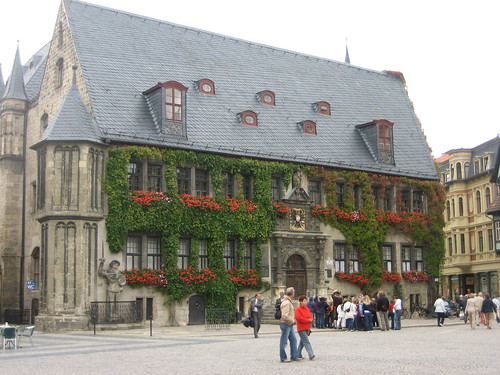
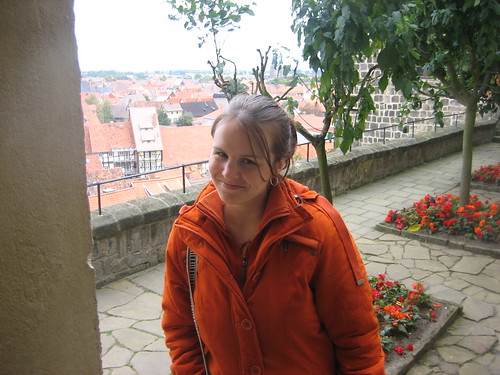
And here are a few shots of the Rathaus (Town Hall), the church and castle on the aforementioned sandstone cliff, and a cute picture of my dear travel buddy on the castle terrace overlooking the town:
 Next up in my Germany photo series is the East Side Gallery, but I'll be blogging about my weekend in Sligo first.
Subscribe to:
Posts (Atom)
