Tuesday, September 30, 2008

Adventures in Germany: Wernigerode

(Okay, maybe not an entry every day. No internet at home for another week or so.)

Soon after Kelly arrived in Berlin we took a train (three trains, to be accurate) south-west to Wernigerode in the Harz mountains. It's a lovely little town full of half-timbered houses built at odd angles, and there was an terrifically festive street fair our first night at which we caught our first glimpse of a half-meter bratwurst. I told Kelly she should get one, you know, for the experience, but I think it would have taken her a week to finish the whole thing.


We wanted to try the coffee at Café Wien (Café Vienna), but we never did get there. Below: Krummelsches Haus, built in 1674, which features allegorical reliefs of various nations on its facade.


Here's a close-up of one panel. Lonely Planet thinks this naked lady (representing America, "reasonably enough") is riding an armadillo, though it looks more like a crocodile.


But Wernigerode's primary attraction is its castle on a hill wreathed in evergreens. I tried taking several shots at a distance, but I'll show you this one instead.


I don't want to tell you too much about this place, marvelous as it is, because I'm actually going to set a small part of my novel here. I'll just say there seemed to be gargoyles, demons, and other creepy things nearly everywhere we looked:

Saturday, September 27, 2008

Adventures in Berlin, part 1

I flew into Berlin a few days before Kelly did, so that I could do some research-y things in the city before we took the train (er, trains) to the lovely little town of Wernigerode in the Harz mountains (about a 3-hour journey south-west of Berlin). Here are a few more random photos from the first few days...Wernigerode tomorrow!

Found outside a random flower shop.


The courtyard outside the German Resistance Memorial Center. It was in this courtyard that Claus von Stauffenberg and others involved in the plot to kill Hitler were summarily executed. (More information on the July 20th plot at Wikipedia.)

And on a much lighter note...

A giraffe made all of legos at the Sony Center, near Potsdamer Platz.

Friday, September 26, 2008

Back from Berlin

Huzzah! It was a great trip—I got plenty of inspiration for the book, and Kelly and I had a lot of fun. Seanan said he felt like he'd been looking at 'Present at a Hanging' since December, so I think I will treat him (and you) to a blog post full o' pics every day for...well, for awhile. I took hundreds, you know.

But for now, here's a random assortment. (I seem to have misplaced my laptop adapter and the battery's running low...)

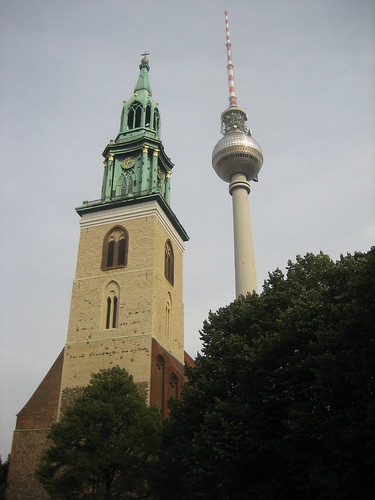
The 13th-century Marienkirche against the GDR-era TV Tower.


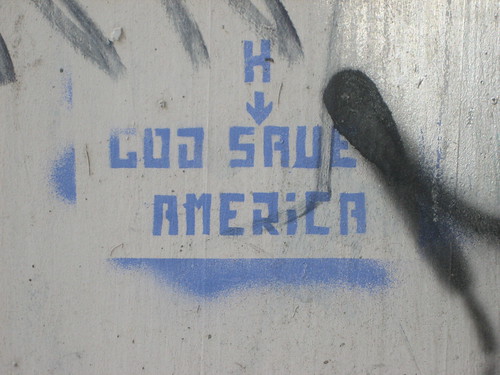
Durty graffiti at the East Side Gallery (a 1.3km stretch of the Berlin Wall painted by an international group of artists in 1989-1990).


(Found on a bridge inside the Tiergarten.)


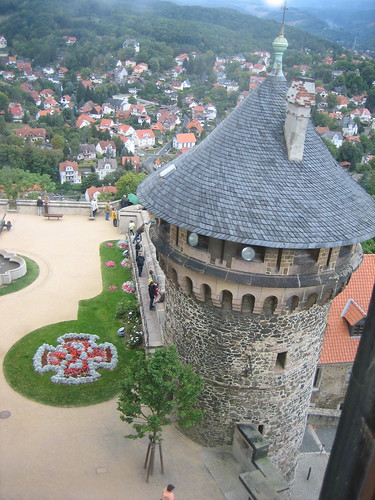
A view from inside the Schloss Wernigerode, in the Harz mountains.

Monday, September 8, 2008

Present at a Hanging

Ghost stories are my (not so guilty) pleasure, as you know, and I'm still sifting through the Librivox catalog looking for old goodies. Right now I'm listening to Present at a Hanging (Gutenberg text here), stories by the American journalist/satirist Ambrose Bierce. So far my favorite is "A Man With Two Lives." These stories are much shorter and sharper than the gothic tales I usually read, and I like that—sometimes a story goes on for thirty or forty pages, and the dénouement isn't as dramatic as all that narrative build-up would suggest. Make sure you read "A Man With Two Lives"—it'll only take you a few minutes.

And speaking of Ambrose Bierce: I've been thinking a lot about epigraphs lately, how they flavor and (hopefully) enhance the reader's experience of the story they're about to read, and I thought I would show you the epigraph that opens Petty Magic:
WITCH, n. 1, Any ugly and repulsive old woman, in a wicked league with the devil.
2, A beautiful and attractive young woman, in wickedness a league beyond the devil.
—Ambrose Bierce, The Devil’s Dictionary
More thoughts on epigraphs in a future entry.

Sunday, August 31, 2008

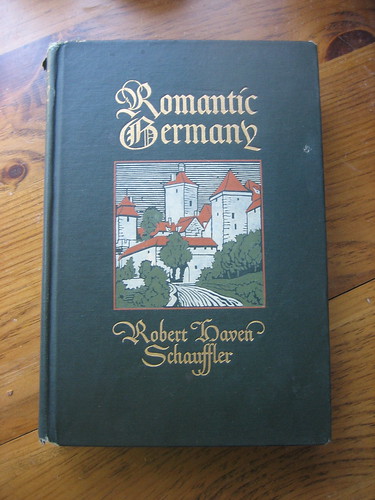
Romantic Germany

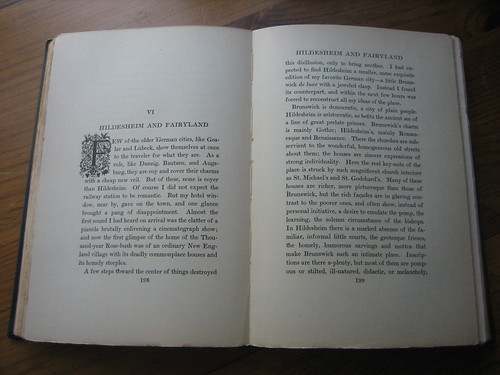
Lately I've been preoccupied with the new novel and spending QT with the fambly before I head back to Galway (tomorrow, weeeeeee!) Thrift-shopping has become an increasingly frequent family activity, and look what ten-dollar treasure I found at the Moorestown Friends' Thrift Shop yesterday:


It was originally $20, but all books were half price this weekend, and my mom got it for me as an early birthday present. (Thanks, Ma!)

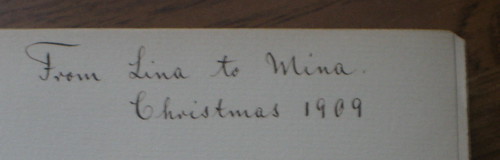
Just look at the dedication!:


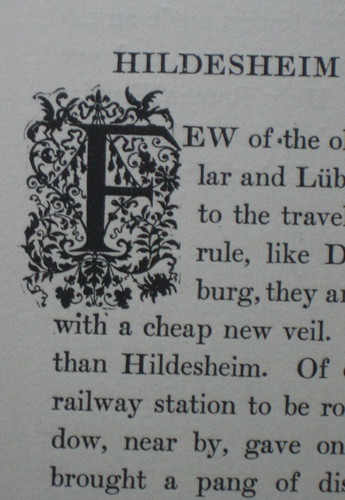
I guess this makes me a bonafide book nerd, but I love when a book has initial letters, the more ornate the better.

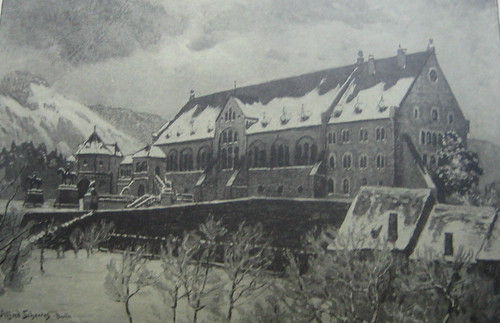
I may have neglected to mention that Kelly and I are heading to Germany in mid-September, which is part of why I was attracted to this fascinating old book. We're spending a few days in Berlin and a few days in the Harz mountains, about three hours' train ride west of the capital. The Grimms got most of their fairy tales from the villages of the Harz, and the region is steeped in witchy legends. Peeeeeerfect. One of the highlights will be a trip here.)

And here:

The first castle is in Wernigerode, the second (the Kaiserhaus) in Goslar (2 hours west by train). Funny how I would've most likely overlooked Goslar and all its attractions were it not for this book:
You appreciate the half-timbered dwellings so much that your appetite is whetted for better ones. If you are persistent you find them at the head of the Markt-Strasse. Crescit indulgens! The taste grows upon you. Presently, unless you are very reserved or blasé, you give a cry of pleasure. You have discovered the Brusttuch, a crooked late-Gothic gildhouse named after an indispensible part of the local peasant's costume. It has an amazingly sharp, high ridge. Its lowest story is of picturesque rough stone; its second is half-timbered and filled with such homely, humorous carvings as riot along the streets of Brunswick. Among them are reliefs of convivial monkeys and of witches riding their broomsticks to the Brocken...
I love the florid descriptions in these old books! It'll be interesting to see how much (or little?) the place has changed in 99 years; it's a little eerie reading about these places as yet untouched by the Third Reich and all its horrors. (By the way, the V-2 factory was located in a subterranean factory in the Harz. Parts of it are open to the public, or so I hear, though I think we'd need a car to get there.)

Anyway, expect a load of pictures here when I get back to Galway in late September...

Wednesday, August 20, 2008

The Book of Spies

"I only regret that I have but one life to lose for my country."

Those are the last words of Nathan Hale, possibly the first American spy, seconds before he was hanged by the British in 1776. Hale, a young Yale-educated schoolmaster, was hired by Washington and betrayed by a loyalist relative. The British military official who condemned him to death allowed him to write farewell letters to his mother, sisters, and fiancé, and then tore them up once the noose was put around Hale's neck.

Right now I'm reading a wonderful "profusely illustrated" history of espionage, Brian Innes' The Book of Spies, published in 1966. I was reading this book in bed the other night, and (as I tend to do) I fell asleep with the light on. My sister came into my room to turn the light off, and while she was in the room I bolted upright in bed and started...well, 'screaming' isn't the word, they were more like little yelping shrieks. (That wimpy noise was in itself embarrassing--I like to think if there really was an intruder I'd be able to scream properly.) Anyway, I'm pretty sure I was having a dream, a scary dream with spies in it, and for those few seconds before I woke up Kate became part of it.


Scared the bejeezus out of my poor mother!


Saturday, August 16, 2008

The Mysterious Stranger

My latest Librivox "read" is Mark Twain's The Mysterious Stranger. Theodore, the young narrator, lives in a small village in Austria in the 16th century. One afternoon while playing in the woods with a few friends, he meets an attractive young man named Satan (nephew of that Satan—angels have family trees too, apparently), who pulls exotic fruits from his pocket, renders himself invisible, makes little men out of clay and animates them, conjures money out of thin air, and performs lots of other tricks for the boys' amusement. In several conversations over the following months, Satan takes pains to tell Theodore and his friends that humanity, to him and his fellow "angels," is as cosmically significant as fleas on an elephant's back. (If that's so, you'd expect he wouldn't bother associating with these base humans at all, but it's all for the sake of the story, right?) His arrival sparks accusations of theft and witchcraft that leave the claustrophobic community in chaos.

Anyway, the following passage totally creeped me out:
"There has never been a just one, never an honorable one--on the part of the instigator of the war. I can see a million years ahead, and this rule will never change in so many as half a dozen instances. The loud little handful--as usual--will shout for the war. The pulpit will--warily and cautiously--object--at first; the great, big, dull bulk of the nation will rub its sleepy eyes and try to make out why there should be a war, and will say, earnestly and indignantly, 'It is unjust and dishonorable, and there is no necessity for it.' Then the handful will shout louder. A few fair men on the other side will argue and reason against the war with speech and pen, and at first will have a hearing and be applauded; but it will not last long; those others will outshout them, and presently the anti-war audiences will thin out and lose popularity. Before long you will see this curious thing: the speakers stoned from the platform, and free speech strangled by hordes of furious men who in their secret hearts are still at one with those stoned speakers--as earlier--but do not dare to say so. And now the whole nation--pulpit and all--will take up the war-cry, and shout itself hoarse, and mob any honest man who ventures to open his mouth; and presently such mouths will cease to open. Next the statesmen will invent cheap lies, putting the blame upon the nation that is attacked, and every man will be glad of those conscience-soothing falsities, and will diligently study them, and refuse to examine any refutations of them; and thus he will by and by convince himself that the war is just, and will thank God for the better sleep he enjoys after this process of grotesque self-deception."
A great writer is often a great prophet as well, no?