Monday, March 15, 2010

Victory Jumper—squee!

(Victory jumper, part 1.)

Is this not the most fabulous thing I have ever knit?!

Pattern: Your Victory Jumper by Home Notes (published June 2, 1945)
Yarn: Regia 4-Ply (kardinal, #1078, just over two skeins) and Lang Jawoll Superwash (all of three skeins of petrol, #0088, and a skein of green, #0116)
Needles: #2.5s for the body, #1.5s for the ribbing
Raveled: here (with full notes on mods made).

I was hoping this would turn out kick-ass so I could wear it in my new author photo (which has yet to be taken). I was also hoping there'd be sunshine this weekend, but alas.

I have only one wish-I'd-done-differently this time, and that's the sleeve length. I wish I'd knit them a couple inches longer so the ribbing doesn't scrunch at the elbows. But that's pretty nit-picky I guess.

(Thanks to Li'l Pete for the photos.)

Wednesday, March 10, 2010

Eastern Europe retroblog: Piatra Craiului

From Sighişoara we took the train to Braşov, a medium-sized town we used as a jumping-off point for a hiking trip in the Piatra Craiului mountains. (Pee-AH-trah Cry-OO-lee.) We also made a day trip to Rasnov, and spent a very wet afternoon at the fortress there:

While we were in Braşov I also got my first (and last) taste of polinka. If the bartender had served me battery acid I wouldn't have known the difference.

So, the hiking trip. We left our extra stuff at the hostel in Braşov and took a train to Zărneşti, a rather frightening little place—ramshackle cement huts, muddy unpaved roads and way too many stray dogs—and hiked to a cabana we'd found in Lonely Planet. We weren't sure what to expect, because the guidebook description was pretty vague (which is a sure sign the author hadn't actually been there; don't ask me how I know); but we were pleasantly surprised to find the place was basically a hotel—rustic but clean and comfortable. In the restaurant Kate and I ordered more polenta with sour cream and defrosted veggies (and we were lucky to find that much!), while Elliot got, ahem, adventurous. To this day I bet he still isn't precisely sure what he ate for dinner.

This dog followed us out of Zărneşti all the way to the cabana. It became such a nuisance that Kate and Elliot named it Sophia, after Kate's crazy freshman-year roommate, and we only got rid of it the following afternoon (yes, it hung around outside the cabana overnight) when some farmers' dogs went after it.

Anyway, we spent most of the following day on a walk deeper into the mountains. When we passed farmsteads with people outside we felt quite awkward, but fortunately nobody laughed at the dumb tourists, or yelled at us to get off their land. We didn't encounter any other hikers, as far as I can recall.

It was getting pretty nippy as we climbed; towards the end we were walking in snow.
Me: “I can’t feel my butt!”
Elliot: “Don’t worry. It’s still there.”
We were going to climb this. Then we decided we'd rather just go back to the cabana and watch Elliot eat some more cat intestines under a giant moose trophy (why didn't I get a picture?)

On the walk back we played GHOST. I insisted that "xylophonic" is a word, but Elliot was having none of it.

Next installment: Sinaia.

Tuesday, March 9, 2010

Process

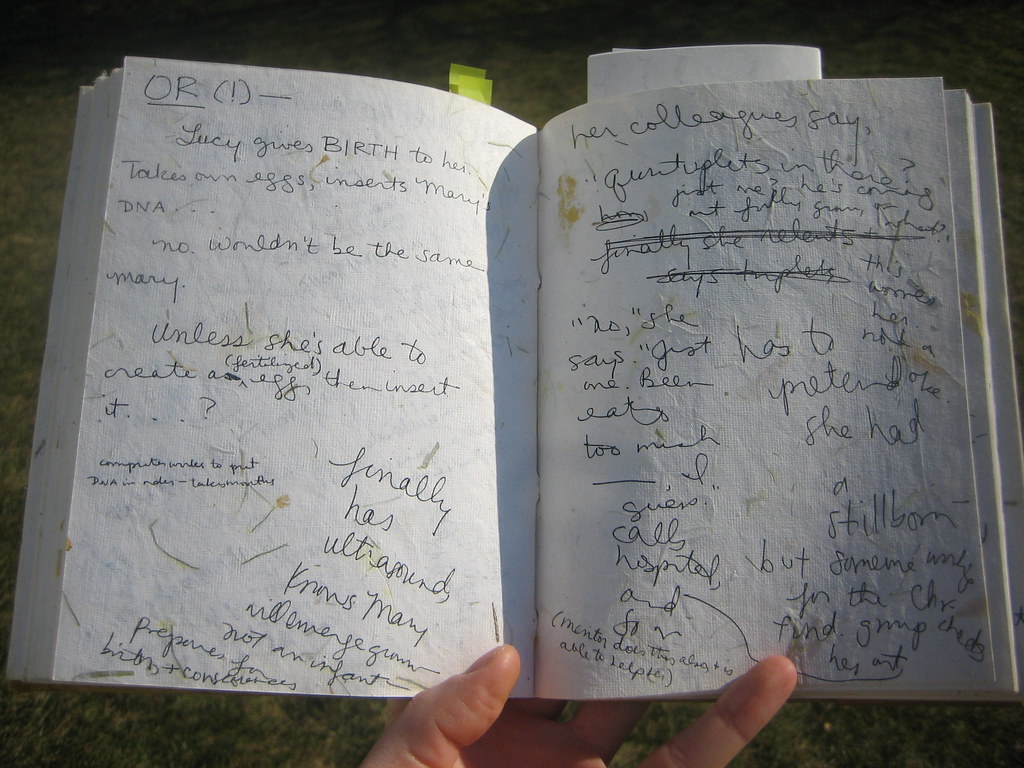
I was sorting through old journals recently, and found some very rough notes for Mary Modern taken before I even got to Galway.

(Better view here. Or just click on the photo.)

I thought it might be fun to put up a few pages to give you a glimpse of the story in its earliest stage of development. (I don't know about you, but I eat this stuff up.)

(Better view here.)

After all, you've got to start someplace...

Friday, March 5, 2010

Eastern Europe retroblog: Sighişoara, part 2

The torture and weapons museums were a barrel of laughs and all, but my favorite sight in Sighişoara is the Church on the Hill. It is the most picturesque graveyard I have ever had the pleasure of wandering through. To get there, you climb a covered staircase dating to the 17th century:

And at the top there's a church (locked, when we went), and a rectory:

(Lucky priests!)

And then there's the graveyard, with all the old headstones tucked into the hillside.


Elliot: "Give me some of that coconut chocolate."
Kate: [farts]

Next: Piatra Craiului.

Thursday, March 4, 2010

Dame Alice

(Here's a bit about the most famous Irish witch, Dame Alice Kyteler, adapted from a Moon Ireland sidebar.)

Easily the most colorful character in Kilkenny history, Dame Alice Kyteler was a businesswoman in the early 14th century who gained more money and power with each husband she acquired. There were four in all, and since each died under mysterious circumstances it was inevitable that Dame Alice should be accused of witchcraft. According to Peter Somerville-Large in Irish Eccentrics, Dame Alice allegedly led her coven in parodies of the Mass using dead men's fingernails and the shrouds of unbaptized boys. "She sacrificed nine red cocks and nine peacock's eyes to her incubus, Art, or Robert, who had carnal knowledge of her in the shape of a cat [or] a hairy black dog..."

Though formally charged in 1324, her influential friends (her brothers-in-law, mostly) had the offending bishop, Richard de Ledrede, imprisoned for seventeen days. The trial commenced upon his release, however, and Dame Alice and her servant girl, Petronilla, were sentenced to burn at the stake. Dame Alice fled the country the night before the execution, leaving loyal Petronilla to her fiery fate on the third of November, 1324. (Somerville-Large gives the 3rd of September, 1325 as the date of execution.)

Alice Kyteler's firstborn son, William Outlawe, agreed to give alms to the poor and re-roof the choir stalls at St. Canice's Cathedral to avoid the gallows. Dame Alice was never seen or heard of again.

If this story captures your imagination as it did mine, you'll want to hunt down a copy of Emma Donoghue's The Woman Who Gave Birth to Rabbits (Half.com link here). "Looking for Petronilla" is the best of the collection.

Tuesday, March 2, 2010

Eastern Europe retroblog: Sighişoara

Sighişoara, a medieval citadel town in Transylvania, was easily my favorite stop in Romania—by turns tranquil and spooky. Plus, Sigguhshwahruh rolls so satisfyingly off the tongue! (We have been informed that this pronunciation is not quite correct, which fortunately does not make our way any less fun to say.)

On the train from Budapest. I'm reading The Pesthouse by Jim Crace, my own personal Santa Claus. (Got oodles of compliments on that t-shirt, including a marriage proposal from another American tourist in Dubrovnik.)

A view of the 14th-century clock tower from the center of town; the view from the top (doesn't it make you want to live here forever and ever?); allegorical clock figures; a shot of the handrail.


It's a long way from Jersey.

Next is Sighişoara part 2: the covered staircase and the Church on the Hill.

Monday, March 1, 2010

Great Book #45: Lord of the Flies

I somehow got out of reading this one in middle school Language Arts class, but I was always curious about it; Lord of the Flies is one of those novels nobody seems to like (or if they do they don't own up to it). It’s a shocking book, but what shocked me most was how much I enjoyed it. I listened to the audiobook narrated by the author, which is always a particular treat since you hear the story exactly as it was intended to be read.

Even if you haven't read this book you've probably heard how ugly it gets: English schoolboys plane-wrecked on a deserted island during World War II attempt to form a civilization, which quickly disintegrates. Ralph is focused on maintaining a signal-fire so they can be rescued, while Jack is only interested in hunting pigs and unseating Ralph as 'chief'. Jack succeeds in turning the rest of the 'tribe' against Ralph, and they literally begin to hunt him down like a wild animal.

It doesn't matter that how they came to be there—why all boys and no girls? evacuated from where, to where? None of the boys mention having been anywhere outside of England—is implausible, and the ending even more so. The boys' descent into savagery is horrifying because it is, for the most part, believable. On any school playground anywhere in the world you can witness myriad minor cruelties that, in the absence of adult supervision, could snowball all too easily; the innocence of childhood is just a veneer over our cruel primal instincts. Jack—what is he, twelve, thirteen?—uses the prospect of a phantom in the forest to rally the boys behind him, paints his face with pig's blood, and does not care that his obsessive ambition to lead the group results in at least two violent deaths. The fearmongering and the struggle for power, the mad despot, the merciless scapegoating and the torturing of anyone who dares to disagree...it all sounds awfully familiar.

Golding's prose can be, erm, too evocative (particularly when the boys go after a wild pig with bloodthirsty glee), but some of the descriptive bits are really splendid: "the lagoon attacked them with a blinding effulgence"; "a sudden communion of shining eyes in the gloom"; "the tree trunks and the creepers that festooned them lost themselves in a green dusk thirty feet above him". And it's not just the jungle atmosphere he nails: "Piggy sat expressionless behind the luminous wall of his myopia." I wonder if somebody with perfect eyesight could understand how apt that sentence is, because I sure do. (Poor Piggy! We never find out what his real name is.)

Golding begins and ends his recording with a conversational bit about how he came to write the book. He said he had to make the group boys only, because if it had been mixed the book would have had to be primarily about sex, and if it had been only girls they would have behaved a whole lot better and there wouldn't have been a story. I don't know about that—at times in my adolescence it certainly seemed like the cattiness of girls was a far more insidious thing than the boys' tendency towards violence and domination—but I did appreciate this: 'I think women are foolish to pretend they are equal to men. They are far superior, and always have been.' As my grandmother says: 'Amen, brother. Amen.'